Lok-to-Clock Electronics
8-11
The TIMING control on each system provides up to 2 ns of adjustment.
If the pulses are more than 2 ns apart, change the length of the cable
between the two Model 3930s (30 cm of cable corresponds to about 1
ns of delay). Do not modify the cables between the laser head and the
Model 3955! When the cable length is optimized, activate the sweep
generator (by pressing the
TIMING button) on the Tsunami “B” Model
3930 and observe the pulses from Tsunami “B” sweeping back and
forth over those from Tsunami “A.”
To overlap the pulses more precisely in time, focus the two Tsunami
output beams in a nonlinear crystal such as
BBO.
*
As you sweep
through the phase-matching angle of the BBO crystal, a frequency-
doubled signal should be observed from each laser. Set the crystal for
an intermediate angle to observe the sum-frequency mixed signal from
both lasers. By activating the sweep generator, the crystal can be easily
phase-matched for observation of this signal. It will be modulated at
the 10 Hz sweep period. Once the sum-frequency mixed signal is
observed, deactivate the sweep generator and use the coarse/fine TIM-
ING
controls to optimize this signal.
A cross-correlation of the two pulses can be generated by displaying
the sum frequency mixed signal on a photodetector and activating the
sweep generator. Alternatively, the cross-correlation signal can be
observed by sending the spatial and temporally overlapped beams into
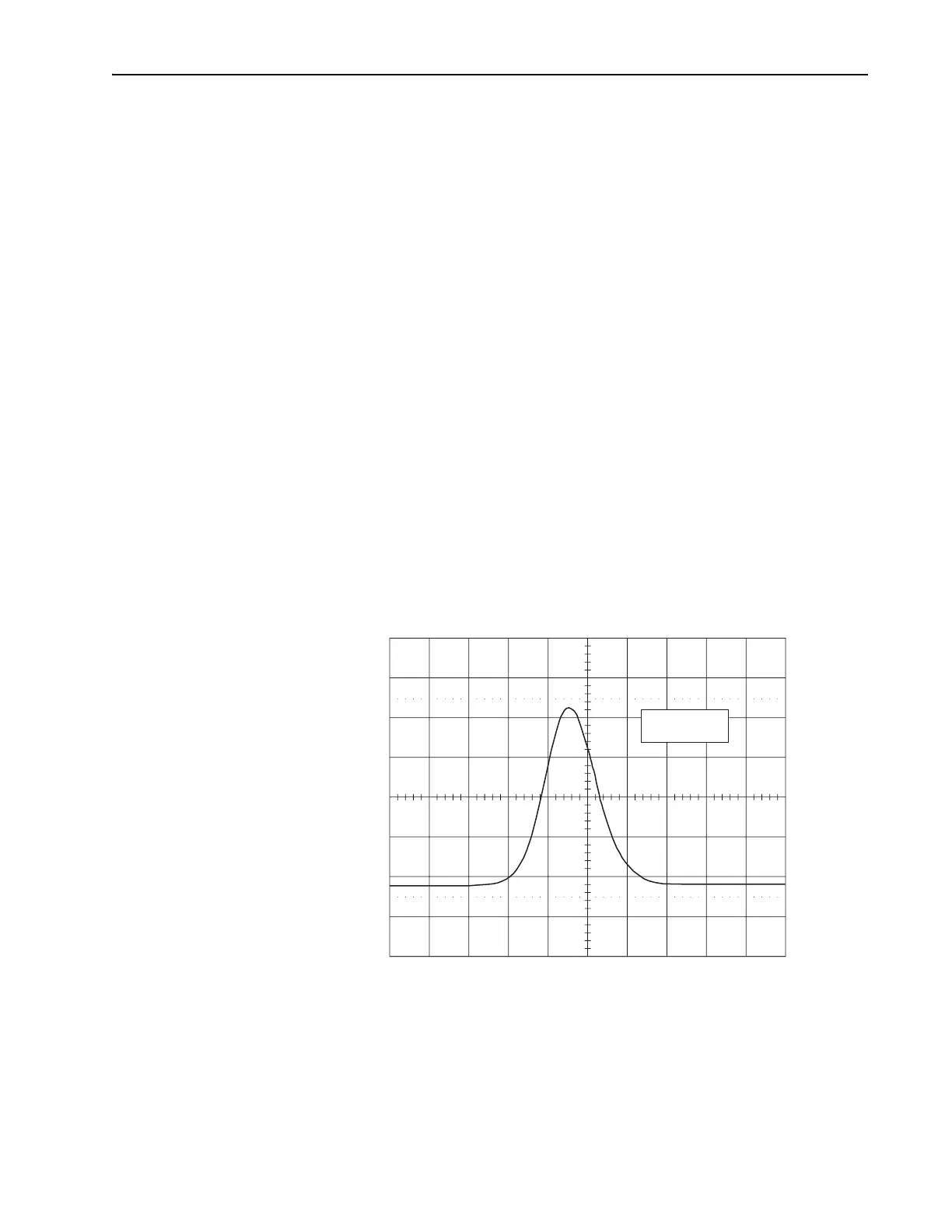
an autocorrelator, such as the Model 409-08. Figure 8-7 shows a typi-
cal cross-correlation trace for two ps Tsunami lasers, each having 1.5
ps pulse widths.
Figure 8-7: Typical cross-correlation signal for two
LTC Tsunami
lasers. The waveform averaged over five seconds. ∆τ = 2.8 ps FWHM.
*
The nonlinear crystal must be cut such that it can frequency-double the output of each
laser. Verify this by temporarily placing a white card at the output of the crystal and then
changing the phase-matching angle of the crystal while watching the laser output on the
card.
2 ps/div


 To Next Page