Tsunami Mode-Locked Ti:sapphire Laser
B-8
[2]
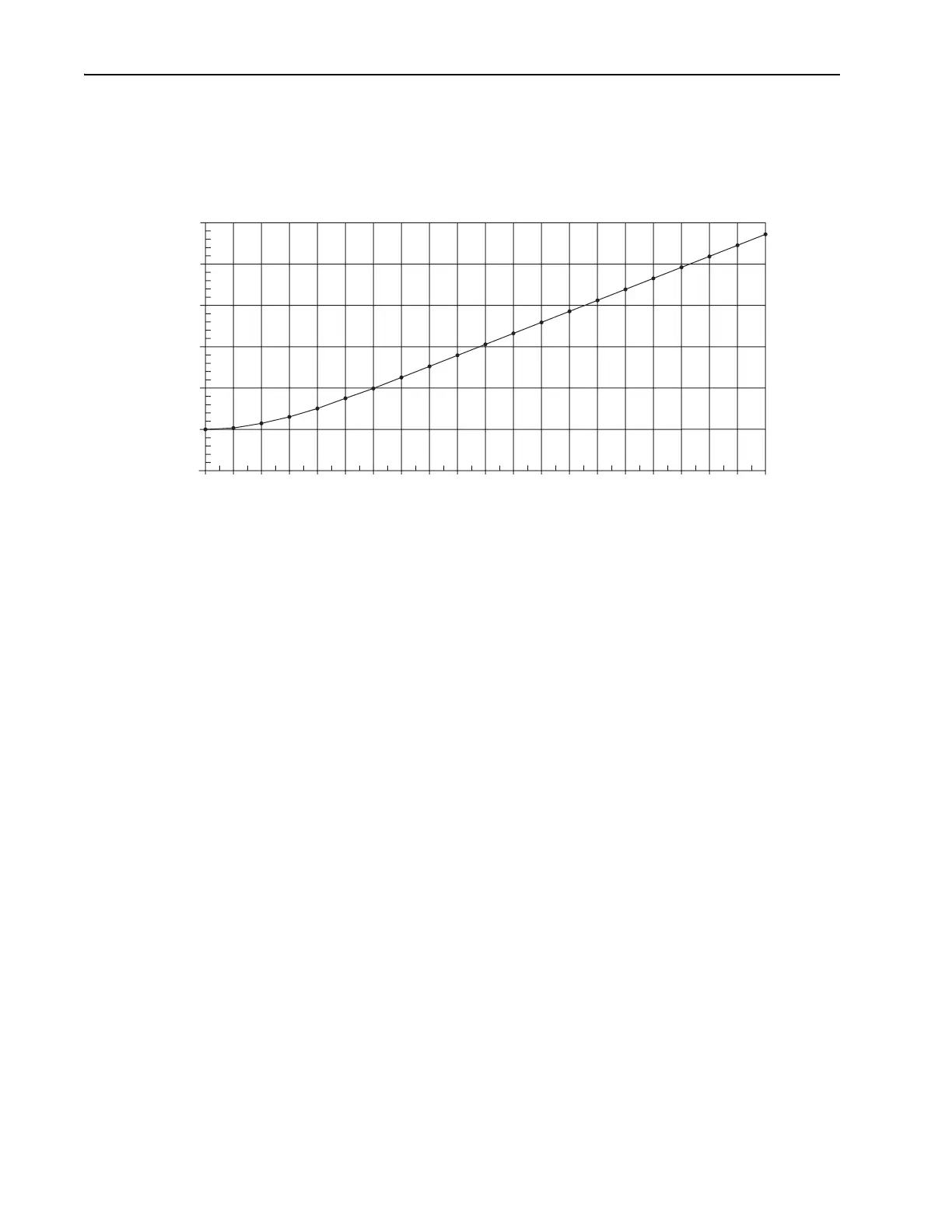
Using Figure B-5, you can relate the value of S to a value for the broaden-
ing B.
Figure B-5: Broadening Curve
When using this equation and graph, it is important to remember that the
values of D
ω
are wavelength sensitive. For example, for BK–7 material, the
difference from 800 nm to 880 nm is 17%. Therefore, it is important to use
the correct value of D
ω
for the operational wavelength. Also, if there are
several materials present, the values for dispersion must be added before
calculating B. For example:
[3]
This provides a simple means for calculating the spacing between prisms
necessary for compensation.
Example 1: Calculating pulse width measured by a Model 409-08 without
pre-compensation.
Assume an 800 nm pulse at the output coupler surface of a Tsunami laser is
55 fs long and transform limited. It passes through 1.9 cm of fused silica
before exiting the Tsunami, and 0.25 cm of BK-7 glass and 0.26 cm of
fused silica in the Model 409-08.
[4]
= 30 · 1.9 + 300 · 0.26 + 450 · 0.25 = 760 fs
2
Therefore S = 760(fs
2
)/(55 fs)
2
= 0.251
Then, looking at our normalized curve (Figure B-5) S = 0.251, and B =
1.22, t
out
= 1.22 · t
in
= 67 fs.
D
ω
L
t
2
in
--------
⋅=
0
1
2
3
4
5
6
0 0.1 0.2 0.3 0.4 0.5 0.6 0.7 0.8 0.9 1.0 1.1 1.2 1.3 1.4 1.5 1.6 1.7 1.8 1.9 2.0
S (Normalized Units)
Broadening (t
out
/t
in
)
D
ω tot()
L
ω tot()
D
ω 1()
L
ω 1()
D
ω 2()
L
ω 2()
…D
ω n()
L
ω n()
++=
D
ω tot()
L
ω tot()
D
ω 1()
L
ω 1()
D
ω 2()
L
ω 2()
+=


 To Next Page