7-6
1234678
5
Waste effluents from the instrument may contain dangerous substances in it and decision about
disposal only has to be made by local water authority.
Warning
SAFETY INFORMATION & WASTE DISPOSAL
INTRODUCTION
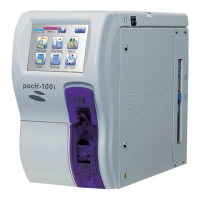
pocH-100
i
Revised March 2013
7.2.2. Stale reagents
Be aware of any warnings and precautions of specific reagents information in this instructions
for use.
Disposal procedures shall meet the local legal requirements.
7.2.3. Waste fluids of instruments
The waste fluids of instruments contain patient blood and are therefore regarded as infectious.
Disposal procedures shall meet the local legal requirements.
Always wear protective garments and gloves when handling the waste fluid.
After work is completed, wash hands with disinfectant!
Biological risks
Always wear protective garments and gloves when handling the waste fluid.
After work is completed, wash hands with disinfectant!
Biological risks
7.2.1. Instrument and its accessories
• Do not dispose the instrument via public recycling!
• Incineration is recommended!
• Contact your local Sysmex service representative and receive further
instructions for disposal!
7.2. WASTE DISPOSAL
Waste Disposal
After becoming waste at end-of-life, this instrument and its accessories are regarded as infec-
tious. They are therefore exempted from EU directive 2012/19/EU (Waste Electrical and Elec-
tronic Equipment Directive) and may not be collected by public recycling to prevent possible
risk of infection of personnel working at those recycling facilities.
Biological risks
Decontamination
Before decontaminating the instrument, be sure to turn off the power supply and unplug the
power cord. This is necessary to avoid the risk of electric shock. When cleaning the instrument,
always wear protective gloves and gown. Also, wash hands after decontamination carefully
with antiseptic solution first and with soap afterwards. Do not open the instrument for decon-
tamination inside. This is executed only by Service Technician.
Important
• To ensure decontamination of the instrument outer surfaces, clean the instrument surface at
the end of the daily work. This has to be executed in the following three situations;
- Regularly, at the end of a daily work,
- Immediately, during contamination with potentially infectious material, and
- In advance of repair or maintenance by the eld technical service representative
• Wipe off the instrument surfaces using a cloth soaked with a suitable decontamination solu-
tion. Please use one-way cloths, e.g. made of paper or cellulose. The cloth may be moistened
in a way only that no wetness may reach the inside of the instrument.
• The indicated residence time of the decontamination solution shall be observed.
• If required, you may afterwards remove normal contaminations with commercial neutral de-
tergent, in case these could not be removed by the decontaminant.
• As a last step the instrument shall be dried with a dry one-way cloth.
Warning
• Do not dispose the instrument, accessories and consumables via public recycling!
• Incineration of contaminated parts is recommended!
• Contact your local Sysmex service representative and receive further instructions for disposal!
Follow local legal requirements at all times.
Warning


 To Next Page