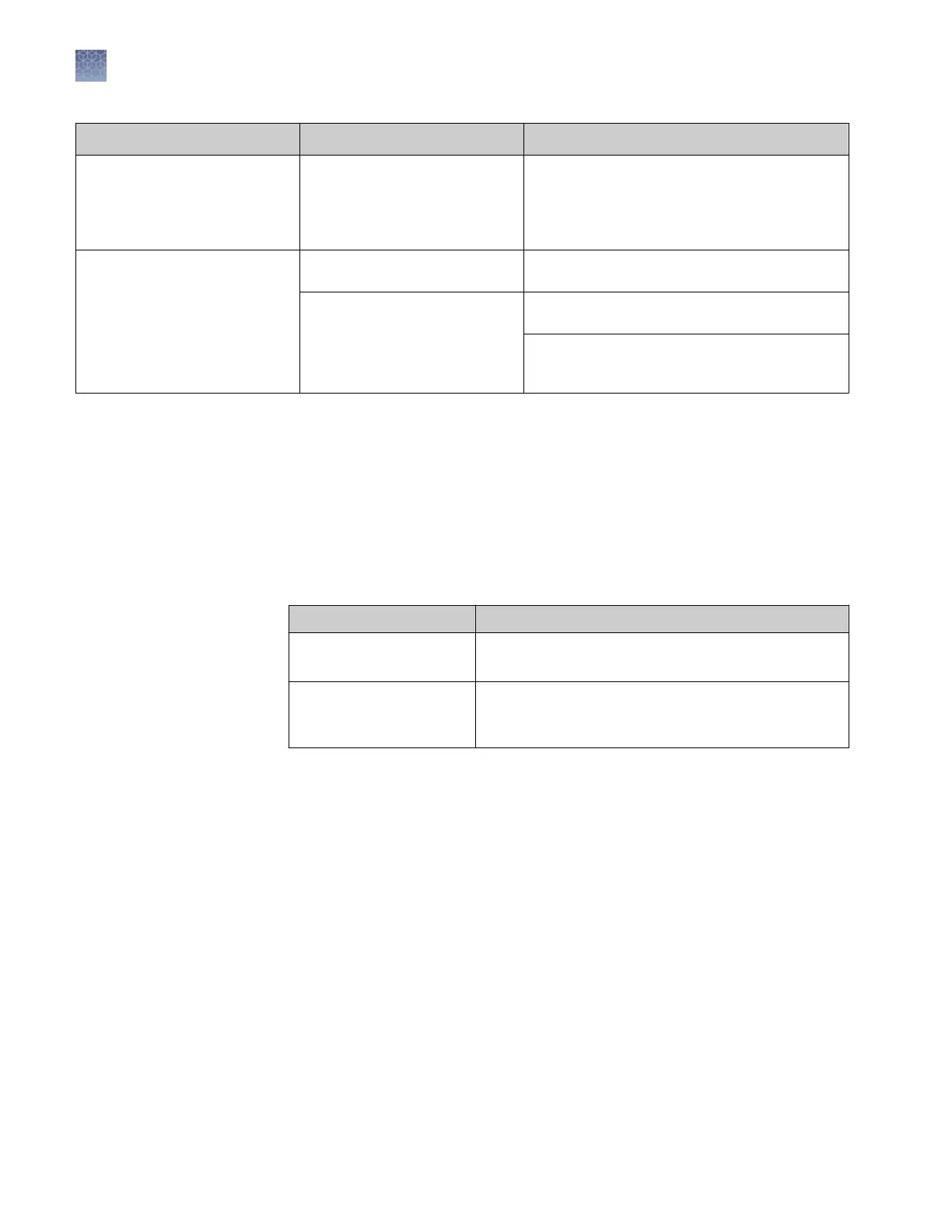
Observation Possible cause Recommended action
High fluorescence signal in
individual wells
Signals that exceed the limit of
normal fluorescence may
indicate fluorescent
contaminants on the plate or
the sample block.
See “Identify contamination“ on page 56.
Calibration failed but plate is
undamaged
The incorrect plate was used
for calibration performed.
Use the plate that matches the calibration
performed.
The plate was improperly
prepared.
Repeat the calibration with the plate properly
prepared.
If the calibration fails again, order a
replacement plate. If the replacement plate
fails, contact Support.
Signals that exceed the limit of normal
uorescence may indicate uorescent
contaminants on the calibration plate or the sample block. Common contaminants
include ink residue from permanent pens, powder from disposable gloves, and dust.
1.
View the calibration data and note the wells that failed the calibration.
2.
Remove the plate from the instrument, rotate the plate 180°, then perform the
calibration again.
3.
Determine the location of the failed wells again as in step 1.
Position of failed wells Action
Identical The sample block is contaminated.
Decontaminate the sample block (see page 71).
Reversed The plate is contaminated.
Discard the plate, then perform the calibration using a
new calibration plate.
4.
If the calibration fails after you decontaminate the sample block and replace the
plate, contact Support.
Whenever possible, use a background plate listed in Appendix D, “Parts and
materials“. These plates contain a buer that accurately simulates the reagents used
for PCR, and, therefore, produces high-quality calibration data.
If a background plate is not available, you can create one as described below.
Required materials:
• MicroAmp
™
optical 96-well reaction plate
• Optical adhesive cover or optical at caps
• Pipeor, 200-µL (with pipee tips)
• Powder-free gloves
• Safety glasses
• Deionized water
Identify
contamination
Create a
background plate
(optional)
Chapter 5 Calibrate and verify instrument performance
Perform ROI/uniformity, background, and dye calibrations
5
56
QuantStudio
™
1 Real-Time PCR System Installation, Use, and Maintenance Guide



 To Next Page