Run the dilution plate as an experiment
1.
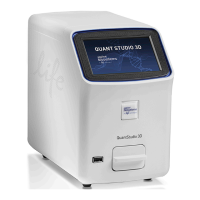
Load the plate into the instrument.
2.
Set up a genotyping experiment on the instrument.
• Load an experiment created in the desktop software.
a. In the home screen, touch Load Experiment.
b. Select the experiment location, then the experiment le.
• Create a new experiment on the instrument touchscreen.
a. In the home screen, touch Open Template4Genotyping4Genotyping
Post.
b. (Optional) In the Properties tab, edit the experiment properties.
c. In the Method tab, set the hold temperature to 60°C with a 2 minute hold
and enter the appropriate reaction volume.
d. In the Plate tab, enter the dilution series information for the appropriate
wells.
3.
Touch Start Run.
4.
When the run is complete, download the results for analysis.
5.
Unload the plate from the instrument.
CAUTION! PHYSICAL INJURY HAZARD. During instrument operation,
the plate temperature can reach 100°C. Allow it to cool to room
temperature before handling.
Determine the optimal dye concentration
Review the dye signal data and select the dilution to use for dye calibrate.
1.
In the Results tab of the desktop software, select Raw Data Plot.
This plot displays the raw uorescence signal of each optical lter, for individual
wells.
Note: The Raw Data Plot cannot be viewed on the instrument touchscreen.
2.
For each replicate population of dilutions, select the wells in the Plate Layout to
view in the plot.
3.
Examine the raw data to identify the wells yielding signals in the 800,000 to
3,200,000 range for the optical lter where the dye is brightest.
4.
(Optional) Export the raw data, then calculate the average uorescence value for
each concentration.
5.
Select the lowest (optimal) dye concentration that falls within the acceptable
signal range.
Chapter 5
Calibrate and verify instrument performance
Calibrate custom dyes
5
64
QuantStudio
™
1 Real-Time PCR System Installation, Use, and Maintenance Guide



 To Next Page