Maintenance
2722−2/A1
Winterthur Gas & Diesel Ltd.
3/ 7
3) Follow the instruction of the injector test bench manufacturer for testing the opening
pressure and tightness.
4) Check opening pressure as follows:
a) Increase the oil pressure slowly until the opening pressure is reached and the
injector sprays.
b) Note the opening pressure. If the opening pressure is below 340bar, see
chapter 3.3 to adjust the opening pressure.
5) Check of the seating surface between the nozzle needle and nozzle body as follows:
a) Adjust the oil pressure to 50 bar below the opening pressure.
b) Monitor the injection valve for 30 seconds. Observe if fuel comes out of the
nozzle.
3.2 Results
1) For the correct function and to use an
injection valve again, read the data
below:
D The opening pressure is between 340
and 410 bar, refer to the test above. The
opening pressure for new injection
valves is approximately 375 bar.
D Most of the fuel will come out as a spray
from the top set of holes in the nozzle tip
at the specified opening pressure.
D At the end of an injection, no fuel must
come out of the nozzle.
2) If the injection valve does not function
satisfactorily, disassemble as given in
paragraph 4, clean all parts and
replace worn parts.
D You must replace nozzle tips that have
worn spray holes.
D Only an authorized company can repair
nozzle holders and nozzle bodies that
have unsatisfactory sealing surfaces.
3.3 Adjust the opening
pressure
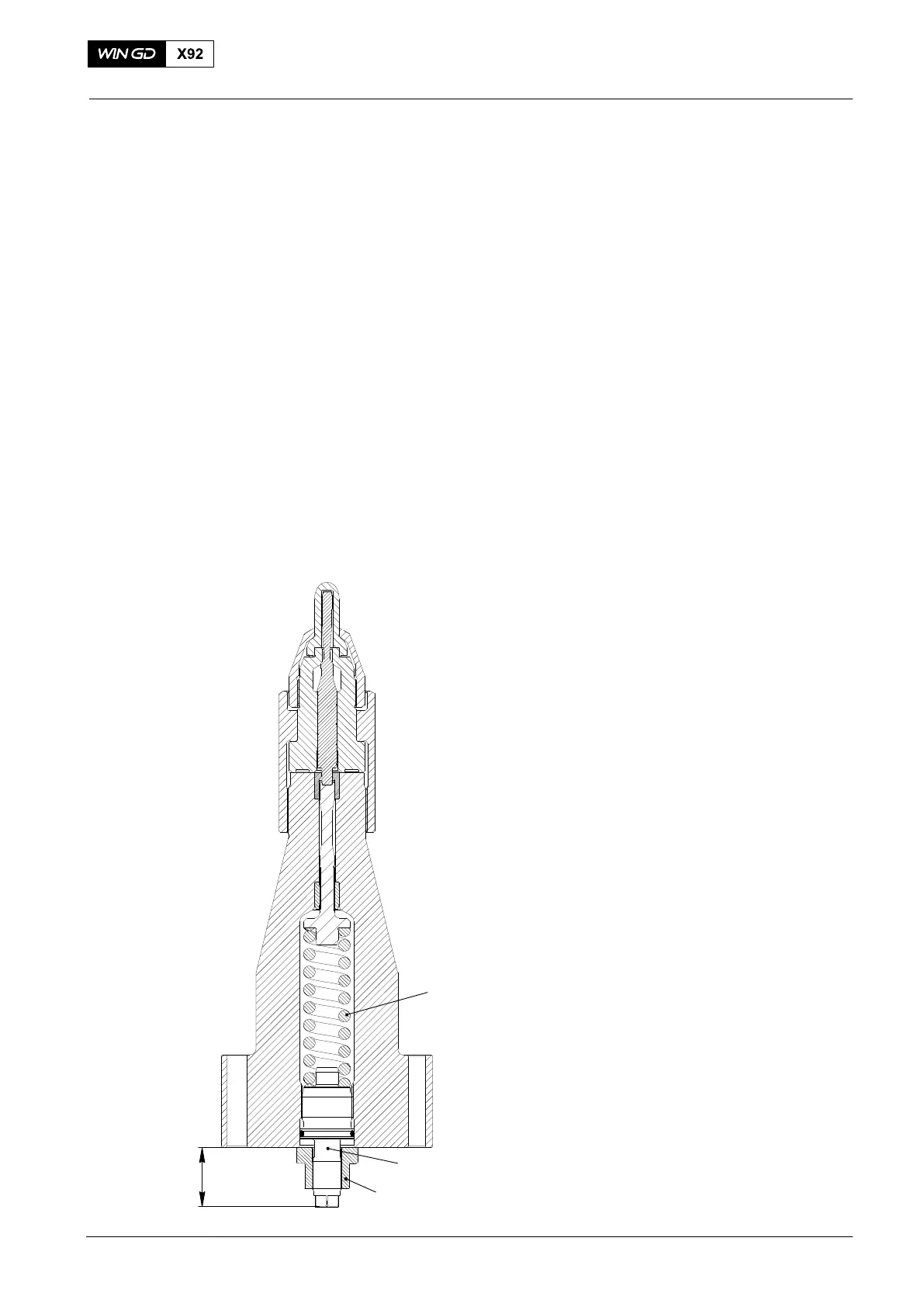
D The injection valve is designed to have
an opening pressure of approx. 375bar
when the spring tensioner (3, Fig.2)
protrudes X = 48mm
1) Measure distance X
1) Loosen the collar nut (11).
2) Turn the spring tensioner 5 turns out
and then in again:
D Less than measured X to increase the
opening pressure.
D More than measured X to decrease the
opening pressure.
3) Tighten the collar nut (11).
4) Check the opening pressure, refer to
chapter 3.1.
2015−08
Injection Valve: Disassemble, Checks, Assemble Injection Valve with FAST
X
8
3
11
Fig. 2



 To Next Page