Ethernet VLL (Epipe) Services
Page 160 7705 SAR OS Services Guide
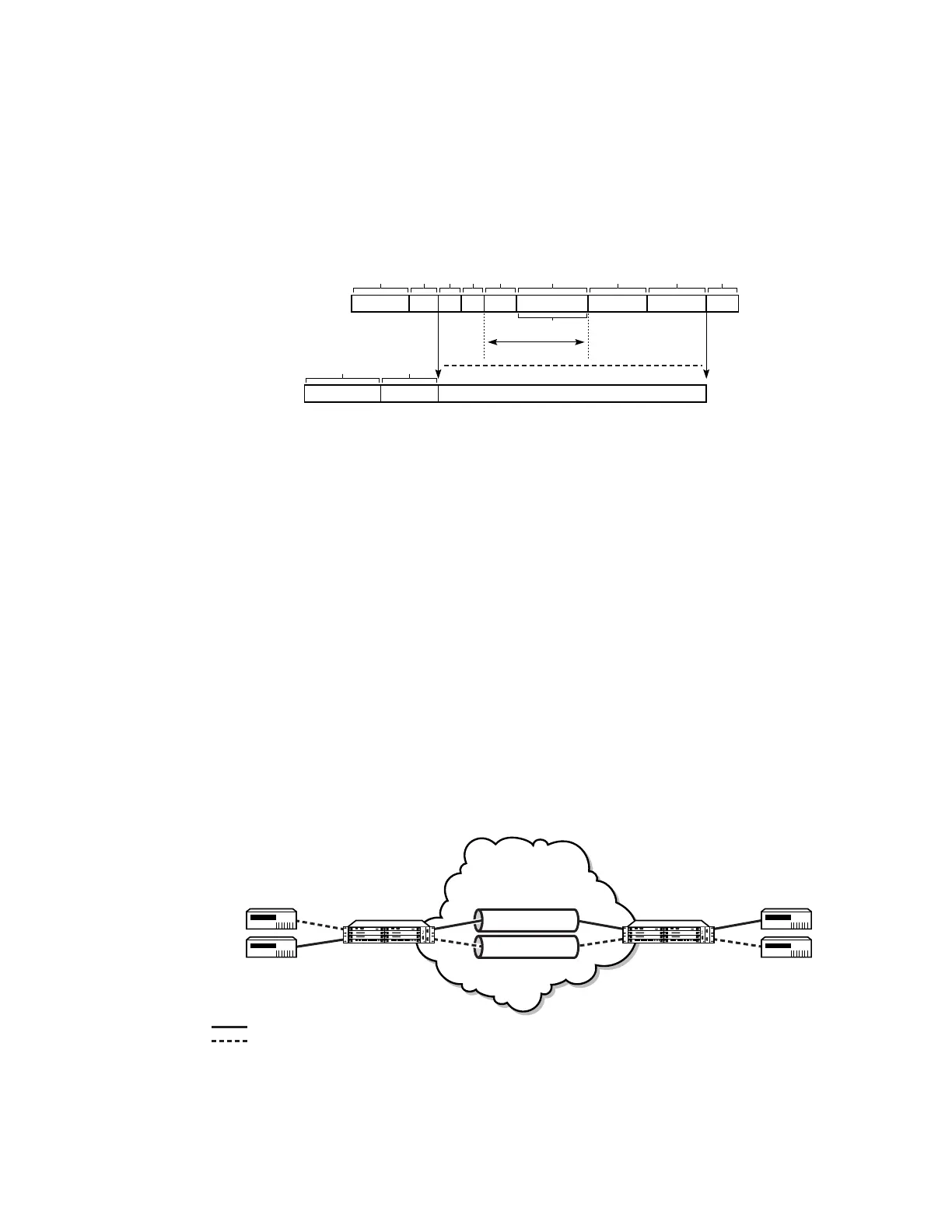
Figure 25 shows a typical Ethernet VLL frame together with its MPLS tunnel encapsulation:
An Epipe service is a Layer 2 point-to-point service where the customer data is encapsulated
and transported across a service provider’s MPLS or IP network. An Epipe service is
completely transparent to the subscriber’s data and protocols. Like other PW VLL services,
Epipe service behaves like a non-learning Ethernet bridge. A distributed Epipe service
consists of a SAP and an SDP pair, where one SDP is on same router as the SAP, and the
second SDP is on the far-end router.
Each SAP configuration includes a specific port on which service traffic enters the
7705 SAR from the customer side (also called the access side). Each port is configured with
an encapsulation type (SAP encapsulation). Thus, a whole Ethernet port can be bound to a
single service (that is, the whole Ethernet port is configured as a SAP), or if a port is
configured for IEEE 802.1Q encapsulation (referred to as dot1q), then a unique
encapsulation value (ID) must be specified.
Figure 25: Ethernet VLL Frame with MPLS Encapsulation
Preamble
Ethernet II
Frame
7
SFD
1
DA
6
SA
6
TPID
2
VLAN | Prio
2
802.1p/q (optional)
TCI
Ethertype
2
Payload
42/46-1500
FCS
4 bytes
MPLS Tunnel
4
PW Label
4
Payload
19767
Figure 26: Epipe Service
19483
IP/MPLS network
Service 1
Service 2
Customer 2
Customer 1
Epipe (VLL)
Customer 1
Customer 2
Epipe (VLL)






 To Next Page