VLL Services
7705 SAR OS Services Guide Page 169
A PPP interface makes use of RFC 1332, The PPP Internet Protocol Control Protocol
(IPCP), PPP IPCP encapsulation of an IPv4 packet. The PW uses the IP Layer 2 transport
pseudowire encapsulation type.
IP Interworking VLL Datapath
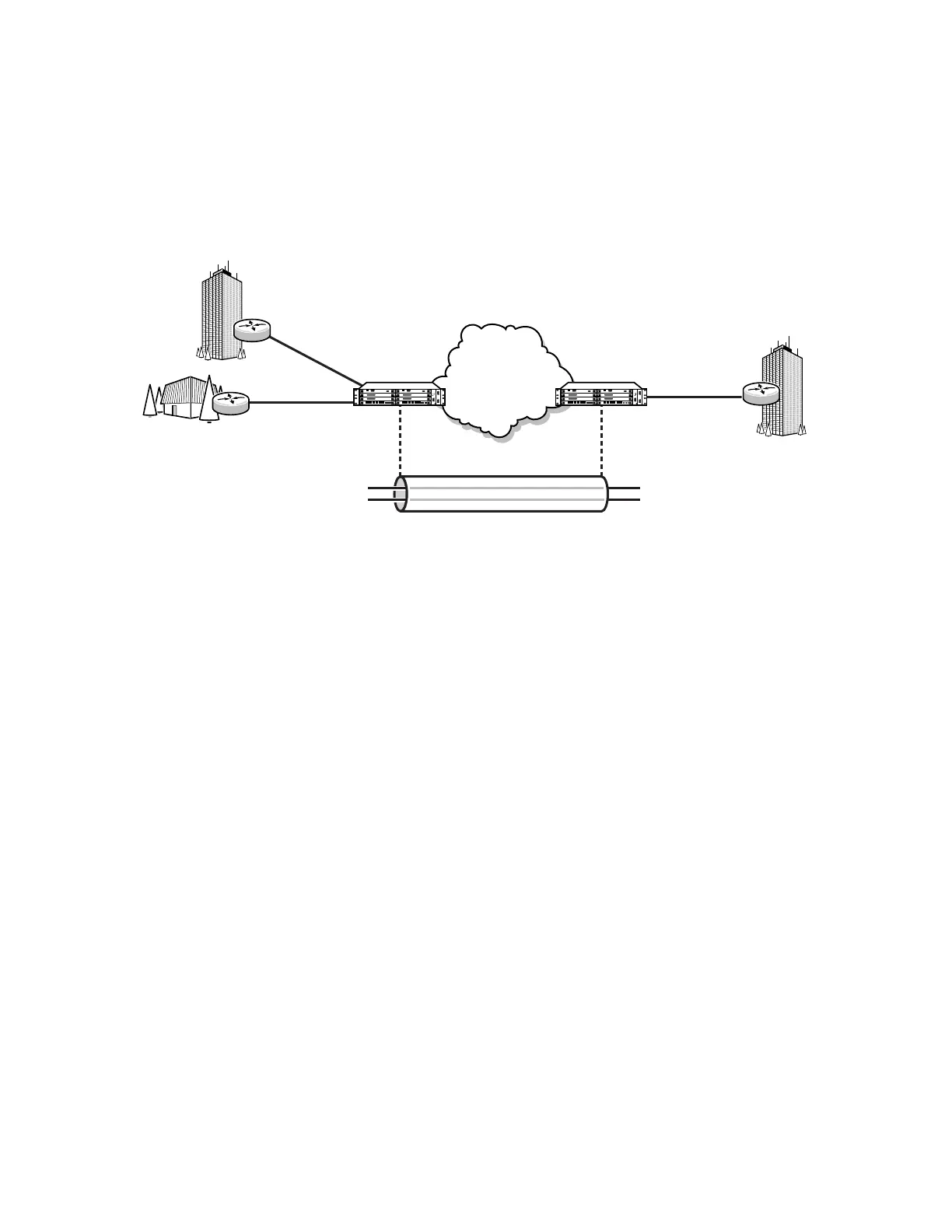
In order to be able to forward IP packets between CE 1 and CE 3 in Figure 28, PE 2 is
manually configured with both CE 1 and CE 3 IP addresses. These are host addresses and
are entered in the /32 format. PE 2 maintains an ARP cache context for each IP interworking
VLL and responds to ARP request messages received on the Ethernet SAP. PE 2 responds
with the Ethernet SAP configured MAC address as a proxy for any ARP request for the CE 1
IP address. PE 2 silently discards any ARP request messages received on the Ethernet SAP
for addresses other than CE 1. Likewise, PE 2 silently discards any ARP request messages
with source IP addresses other than CE 3. In all cases, PE 2 keeps track of the association of
IP to MAC addresses for ARP requests it receives over the Ethernet SAP. All entries are
subject to aging.
In order to forward unicast frames destined for CE 3, PE 2 needs to know the MAC address
of CE 3. If there is no entry in the ARP cache, PE 2 sends an ARP request message for the
CE 3 MAC address over the Ethernet SAP.
IP broadcast and IP multicast packets are sent on the Ethernet SAP using the broadcast or
direct-mapped multicast MAC address.
Figure 28: IP Pseudowires Between SAR Nodes
20146
CE-1
CE-2
IP Pseudowires
MPLS LSP
PPP
PPP
Ethernet
7705 SAR
PE1
7705 SAR
PE2
Metro
Ethernet
IP/MPLS
CE-3






 To Next Page