Internet Enhanced Service
7705 SAR OS Services Guide Page 333
IES for Customer Traffic
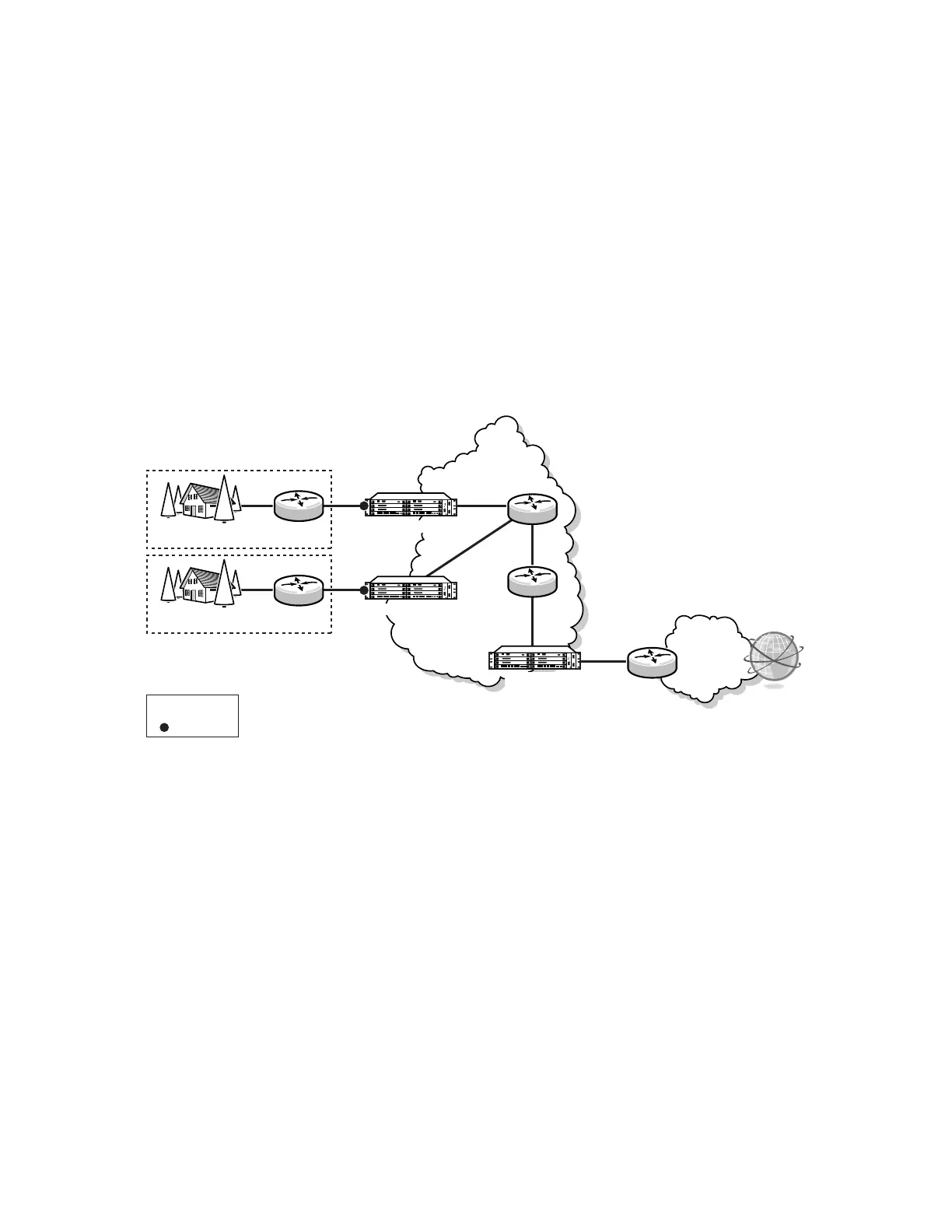
IES provides IP connectivity between customer access points. From the customer’s
perspective, IES provides a direct IP connection and can be used for Internet connectivity, as
shown in Figure 40. The customer is assigned an IP interface and a SAP is associated with
the IP interface to designate a customer access point to the service — one SAP per interface.
SAPs can be MC-MLPPP, PPP/MLPPP or null/dot1q Ethernet. SDPs are not required,
because traffic is routed rather than being encapsulated in a tunnel.
In Release 3.0, IES supports static routes on customer IP interfaces (that is, SAPs). These
routes are redistributed into the global routing table of the 7705 SAR.
IES is supported on any port on the 16-port T1/E1 ASAP Adapter card or 7705 SAR-F
T1/E1 port. IES is also supported on any port on the 8-port Ethernet Adapter card (v1 and
v2) or 7705 SAR-F Ethernet port. Ports must be in access mode. The encapsulation type for
the T1/E1 ports must be ppp/mlppp/mc-mlppp, and the encapsulation type for the Ethernet
ports must be null or dot1q.
More than one Internet Enhanced Service can be created for a single customer ID, and more
than one IP interface can be created within a single IES. All IP interfaces created within an
IES belong to the same customer.
Figure 40: IES for Customer Access to the Internet
Internet
ISP
IES SAP
Legend:
Core
Backbone
IGP Routing
7705 SAR
7705 SAR
Customer A Site 1
Customer A Site 2
7705 SAR
20720






 To Next Page