7-3
7.3 Calibration
7.3 Calibration
Do not start the performance tests until the MT8801C and measuring instruments
have warmed up for at least 24 hours and they have stabilized completely. To obtain
the best measurement accuracy, do the calibration at room temperature. Keep AC
power voltage fluctuations, noise, vibration, dust, humidity, and any other factors
which can affect results to a minimum.
7.3.1 Calibrating the reference crystal oscillator
The stability of the MT8801C reference crystal oscillator is ±2 × 10
–8
/day. Calibrate
the frequency of the reference crystal oscillator by using a reference signal generator
generating a reference signal that is either locked to a standard wave or to the sub-
carrier of a TV broadcast on a color TV (the sub-carrier will be locked to a rubidium
atomic standard).
(1) Specifications
Reference oscillator
Standard type
(after 24-hour operation)
Frequency
10 MHz
Aging rate
2 × 10
–8
/day
Temperature characteristics
±5 × 10
–8
(0 to 50 ˚C)
(2) Instruments required for calibration
• Frequency counter: 10 MHz external reference input, resolution: 1 Hz
• Frequency standard: Standard radio-wave receiver or equipment having
equivalent function
(accuracy better than 1 × 10
–9
)
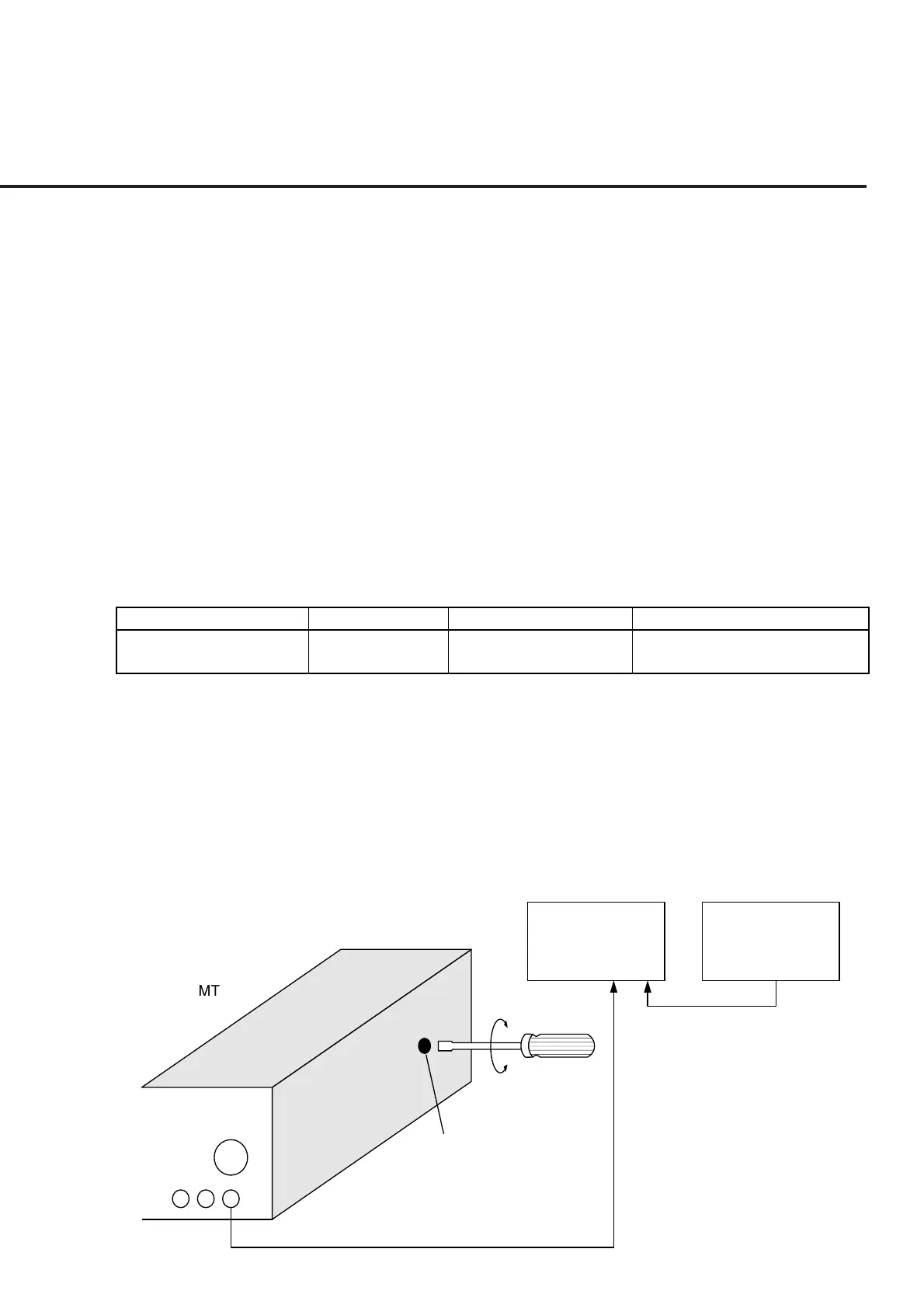
(3) Setup
Frequency counter Frequency standard
OUTPUT
10 MHz STD REF INPUT
MT8801C
Calibration hole
Signal-generator output (1000 MHz)






 To Next Page