Trigger 45
6.7.2 Slope Trigger
The slope trigger looks for a rising or falling transition from one level to another level in greater than or less than a
certain amount of time.
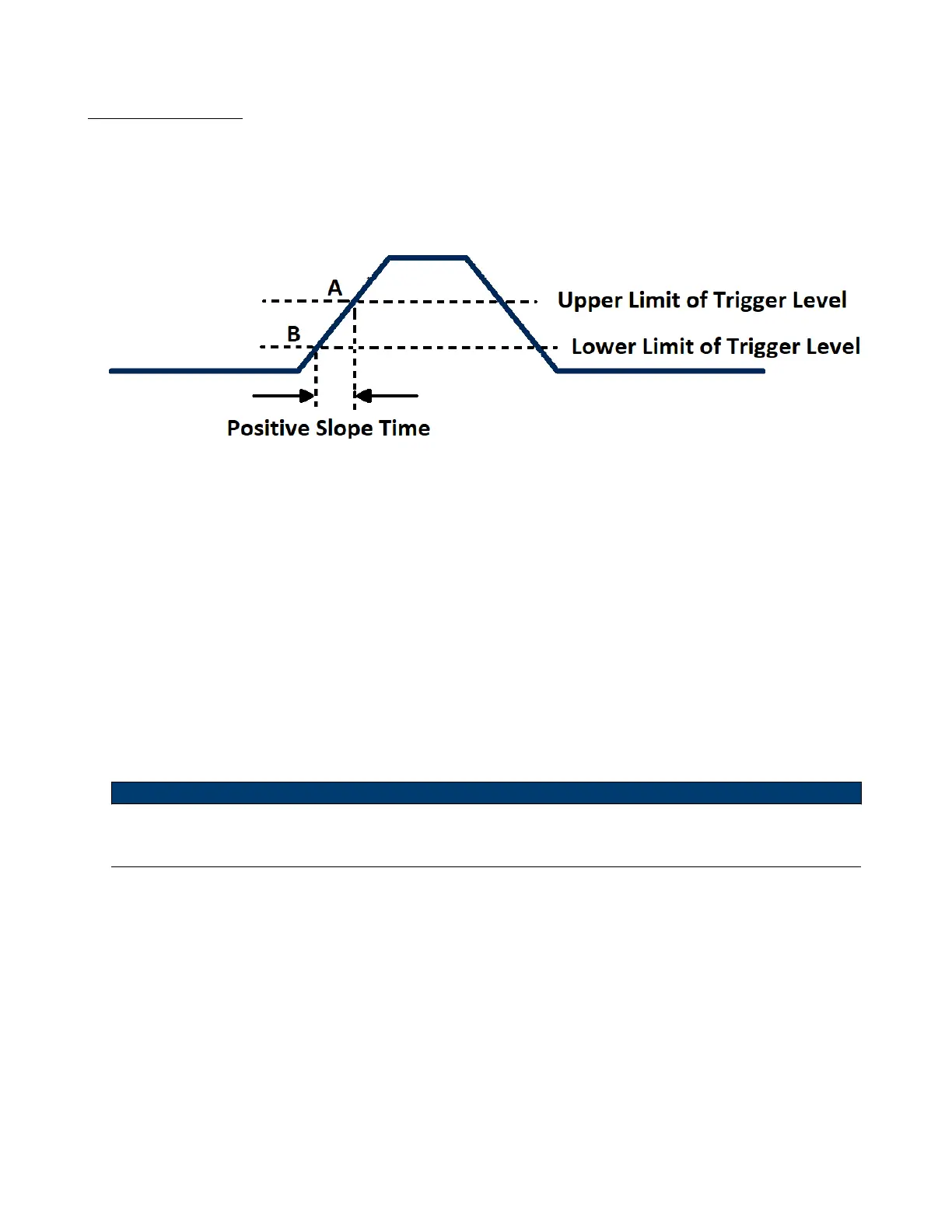
In the oscilloscope, positive slope time is dened as the time dierence between the two crossing points of trigger level
A and B with the positive edge as shown in the gure below.
Figure 6.10 Slope Trigger
1. Press the Setup key to enter the Trigger Menu.
2. Press the Type softkey to view the available trigger types.
3. Turn the Universal Knob
4. Select Slope and push the Universal Knob to select the trigger source.
5. Press the Slope softkey and turn the Universal Knob to set select the desired trigger edge (rising or falling)
– Push down the knob to conrm.
6. Press the Lower Upper softkey to select the Lower or Upper trigger level.
– Turn the Trigger Level Knob to adjust the position.
– The lower trigger level cannot be higher than the upper trigger level.
Note:
In the trigger state message box, L1 means the upper trigger lever while L2 means the lower trigger level
7. Press the Limit Range softkey.
8. Turn the Universal Knob to select the desired slope condition, and push the knob to conrm.
• <= (less than a time value): Trigger when the positive or negative slope time of the input signal is lower than
the specied time value.
• >= (greater than a time value): Trigger when the positive or negative slope time of the input signal is greater
than the specied time value.
• [- - . - -] (within a range of time value):Trigger when the positive or negative slope time of the input signal
is greater than the specied lower limit of time and lower than the specied upper limit of time value.
• - -][- - (outside a range of time value): Trigger when the positive or negative slope time of the input signal is
greater than the specied upper limit of time and lower than the specied lower limit of time value.




 To Next Page