5-12 2002 Buell P3: Electric Starter
HOME
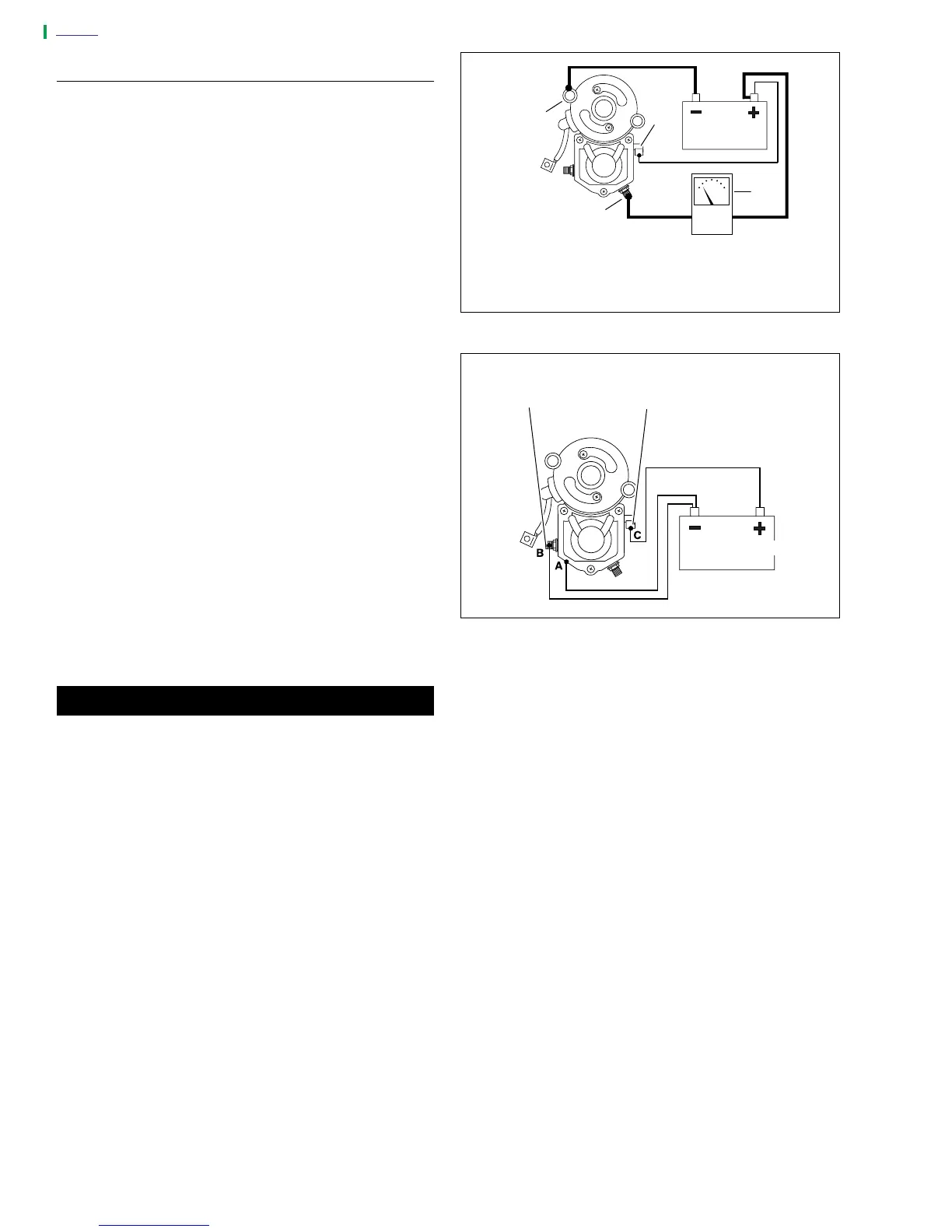
TESTING ASSEMBLED STARTER
Free Running Current Draw Test
1. Place starter in vise, using a clean shop towel to prevent
scratches or other damage.
2. See Figure 5-12. Attach one heavy jumper cable (6
gauge minimum).
a. To the starter mounting flange (1).
b. To the negative (-) terminal of a fully charged bat-
tery.
3. Connect a second heavy jumper cable (6 gauge mini-
mum).
a. To the positive (+) terminal of the battery.
b. To an inductive ammeter (2). Continue on to the bat-
tery terminal (3) on the starter solenoid.
4. Connect a smaller jumper cable (14 gauge minimum).
a. To the positive (+) terminal of the battery.
b. To the solenoid relay terminal (4).
5. Check ammeter reading.
a. Ammeter should show 90 amps maximum.
If reading is higher, disassemble starter for inspection.
b. If starter current draw on vehicle was over 130 amps
and this test was within specification, there may be a
problem with engine or primary drive.
Starter Solenoid
NOTE
Do not disassemble solenoid. Before testing, disconnect field
wire from motor terminal as shown in Figure 5-13.
CAUTION
Each test should be performed for only 3-5 seconds to
prevent damage to solenoid.
NOTE
The solenoid Pull-in, Hold-in, and Return tests must be per-
formed together in one continuous operation. Conduct all
three tests one after the other in the sequence given without
interruption.
Solenoid Pull-in Test
1. See Figure 5-13. Using a 12 volt battery, connect three
separate test leads as follows:
a. Solenoid housing to negative battery post.
b. Solenoid motor terminal to negative battery post.
c. Solenoid relay terminal to positive battery post.
2. Observe starter pinion.
a. If starter pinion pulls in strongly, solenoid is working
properly.
b. If starter pinion does not pull in, replace the sole-
noid.
Figure 5-12. Free Running Current Draw Test
Figure 5-13. Pull-In Test
1. Mounting Flange
2. Induction Ammeter
3. Battery Terminal
4. Relay Terminal
a0168x5x
1
3
2
4
Battery
Battery
a0169x5x
Motor Terminal
Relay Terminal



 To Next Page