2-6 2002 Buell P3: Chassis
HOME
WHEELS 2.4
GENERAL
Good handling and maximum tire mileage are directly related
to the care of wheels and tires. Regularly inspect wheels and
tires for damage and wear. If handling problems occur, see
Tabl e 2-2.
Keep tires inflated to the recommended air pressure. Always
balance the wheel after replacing a tire.
11WARNING1WARNING
Do not inflate any tire beyond its maximum inflation
pressure as specified on tire sidewall. Overinflation may
lead to premature tire failure which could result in death
or serious injury.
TROUBLESHOOTING
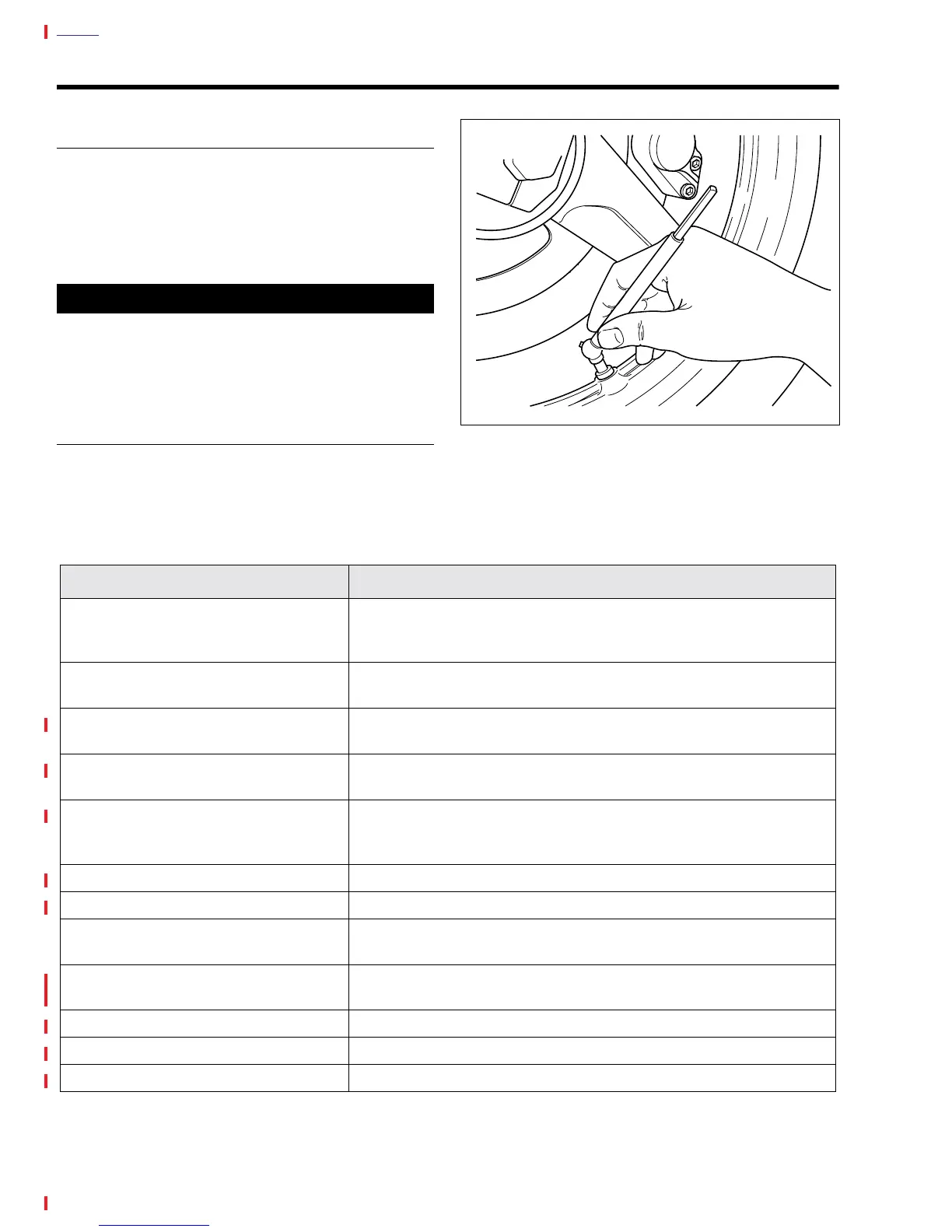
See Figure 2-2. Check tire inflation pressure at least once
each week. At the same time, inspect tire tread for punctures,
cuts, breaks and other damage. Repeat the inspection before
long trips.
Figure 2-2. Checking Tire Inflation Pressure
a0198x2x
Table 2-2. Wheel Service
CHECK FOR
REMEDY
Loose axle nuts. Apply LOCTITE THREADLOCKER 243 (Blue) and tighten front axle nut
(metric) to 38-42 ft-lbs (52-57 Nm).
Tighten rear axle nut (metric) to 48-52 ft-lbs (65-71 Nm).
Excessive side-play or radial (up-and-down)
play in wheel hubs.
Replace wheel hub bearings.
Alignment of rear wheel in frame or with
front wheel.
Repair swingarm as described under 2.19 SWINGARM.
Rims and tires out-of-true sideways; should
not be more than 0.080 in. (2.03 mm).
Replace rims. See 2.9 TIRES.
Rims and tires out-of-round or eccentric
with hub; should not be more than 0.090 in.
(2.29 mm).
Replace rims. See 2.9 TIRES.
Irregular or peaked front tire wear. Replace as described under 2.5 FRONT WHEEL or 2.9 TIRES.
Correct tire inflation. Inflate tires to correct pressure. See 2.2 TIRE SPECIFICATIONS.
Correct tire and wheel balance. Static balance may be satisfactory if dynamic balancing facilities are not
available. However, dynamic balancing is strongly recommended.
Steering head bearings. Correct adjustment and replace pitted or worn bearings. See 2.18 FORK
STEM AND BRACKET ASSEMBLY.
Damper tubes. Check for leaks. See 2.17 FRONT FORK.
Shock absorber. Check damping action and mounts. See 2.15 REAR SHOCK ABSORBER.
Swingarm bearings. Check for looseness. See 2.19 SWINGARM.


 To Next Page