Revision 1 13 9/10/2019
Section 1 Phosgene Analyzer
1.1 Overview
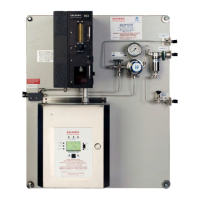
The Galvanic Applied Sciences Model 903W Phosgene analyzer is designed to measure
Phosgene (PH
3
) in a gaseous stream.
1.2 Principle of Operation
The analyzer relies on the chemical reaction between phosgene and 4-(4-
Nitrobenzyl)pyridine and N-Benzyl Aniline to form a red color complex.
When a paper tape that has been impregnated with and 4-(4-Nitrobenzyl)pyridine and N-
Benzyl Aniline is exposed to phosgene, a red color complex will be formed on the tape. The
rate of colour change on the tape is directly proportional to the concentration of phosgene in
the gas stream. When the rate of colour change is measured, the concentration of phosgene
in the gas stream can be determined.
.
The analyzer can use two different analysis algorithms to determine the concentration of
phosgene in the sample.
Standard Analysis (Peak Detect) - In the standard analysis method, the rate of stain
formation on the tape is monitored. The point at which the rate of stain is at a maximum
represents the concentration of phosgene in the sample gas.
Timed Analysis. In the timed analysis algorithm the average rate of stain on the tape is
calculated over a fixed period of time.


 To Next Page