Affinity
2.0
Additional Information Page 141
Recommended masking intensity
The masking help can indicate a recommended masking intensity. If masking is indeed required and also
possible, the recommended masking intensity is given by the minimum required masking level plus a fixed
preferred amount:
Recommended Dial
c = Dial – IaA + (ACc – BCc) + preferred additional amount
The recommended masking level is adjusted for values that cannot be reached by the masking transducer
due to maximum values.
When the auto masking feature is used, masking intensities are set to the recommended intensity. Of course
if “extended range” is not switched on, the masking intensities are thereby limited accordingly.
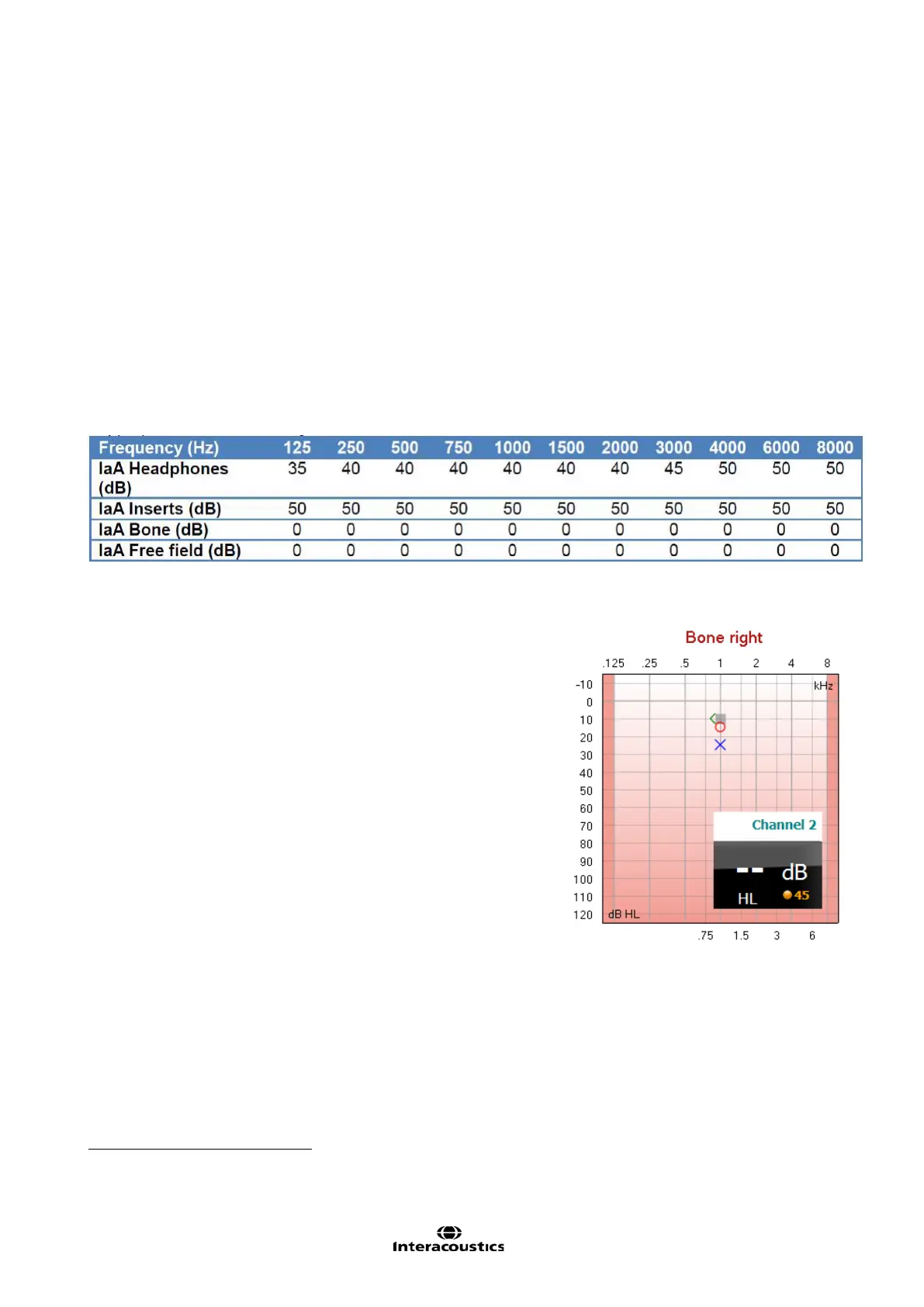
Frequency specific inter-aural attenuation
The default inter-aural attenuations used by the masking help are frequency specific and can be customized
in the setup. The following table shows the default inter-aural attenuation values (IaA). These are partly
based on recommendations from the Handbook of Clinical Audiology
36
and are otherwise slightly more
conservative then recent publications and will therefore allow for appropriate decision making.’
Recommendations
• Experienced audiologists are recommended not to use the option of viewing a suggested masking
level.
• The masking help indicates if masking is performed
correctly with the information given at the time of the
measurement. When measuring the second ear, more
information becomes available and it is not guaranteed that
the earlier measurements are still correct. By measuring the
best ear first and completing air conduction on both ears
before measuring bone conduction, most errors can be
avoided.
• Although clinicians do often not apply masking for bone
conduction in the instance where the air-bone gap is less
than 15 dB in the better ear, it can be recommended to
apply masking to make the measure ear specific. Despite
that experienced clinician would disagree, the masking help
will in these cases recommend that masking is needed.
(This figure illustrates such situation.)
36
Jack Katz et al. (2002), Handbook of Clinical Audiology fourth edition, Williams & Wilkins






 To Next Page