Affinity
2.0
Additional Information Page 189
2.7.4.3 Own Mould versus SPL Probe
Whether the RECD is performed using the client’s own ear mould or the SPL probe may have an effect on
the result. The benefit of using the client’s own ear mould is that the measurement will reflect your client’s
actual residual volume when wearing their hearing device whereas the SPL probe only provides an estimate.
However, you may be in a situation where the mould is nonexistent, broken, or has an extremely bad fit.
Furthermore, you might need to conduct measurements on children not willing to co-operate. In these
situations the SPL probe offers the benefit of easy probe placement and measurement.
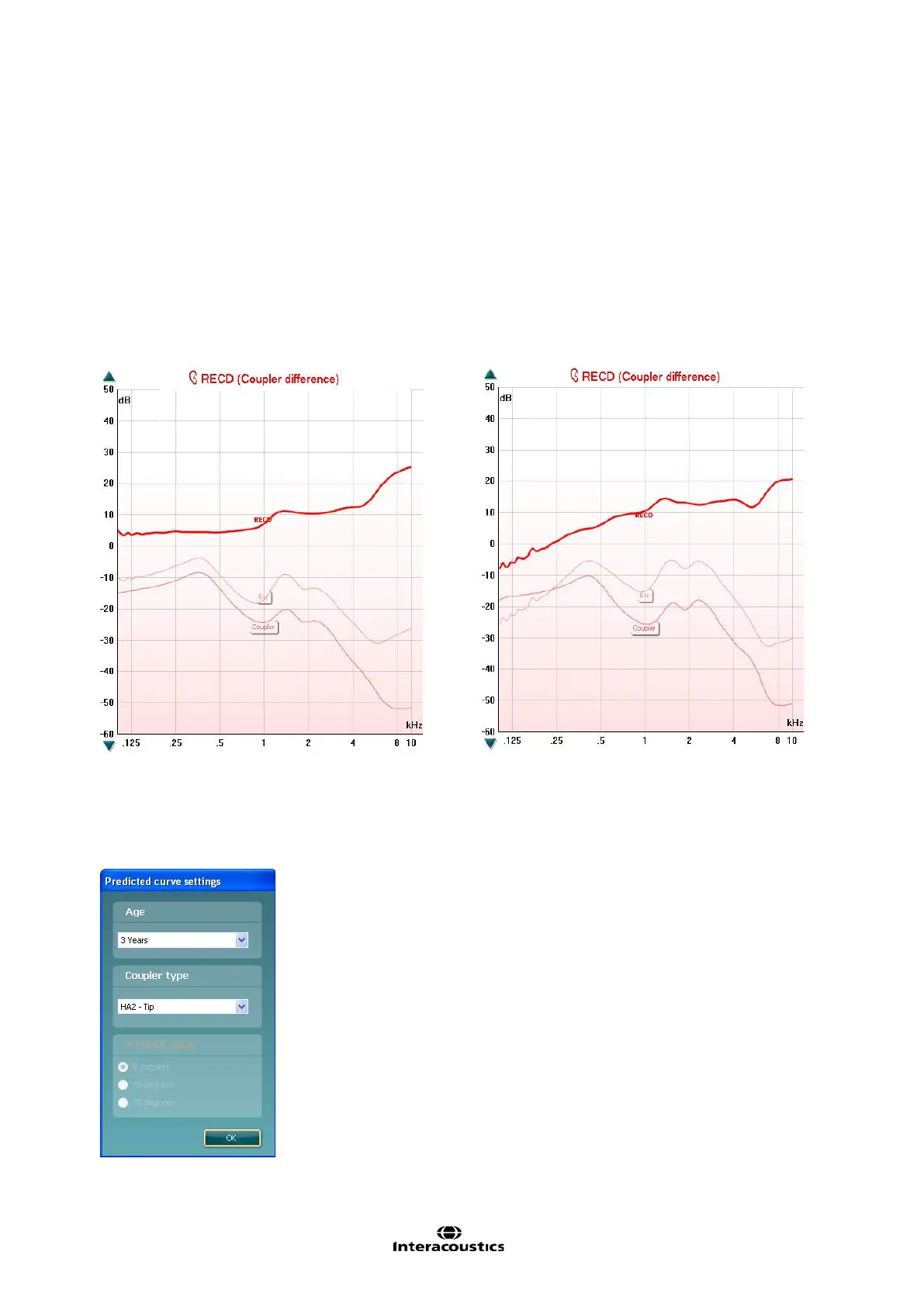
Below see two RECD measured in the same ear using the SPL probe and own ear mould respectively.
Note: the differences between the two ways of measuring. As can be seen above the curve measured with
the client’s own ear mould is below 0 in the low frequencies. This may be due to ear mould effects such as
the tightness of the fit and venting and in the insertion depth of the SPL probe or ear mould.
2.7.4.4 Predicted RECD Curve
Right click on the RECD in the protocol list to use a predicted curve. Select Show predicted curve and the
screen below will appear:
Choose the Age and Azimuth angle using the dropdown lists.






 To Next Page