13 Global menus and settings | 157
o If the filtered control on receive is contained in the running MIDI file, it is
transmitted to the MIDI OUT output and sent to external drives.
o Vice versa, if the filter is in transmission but not in reception, it will be
possible through an external device connected to the MIDI IN of the
instrument to send the control on the specific channel, but this cannot be
sent to an external module via the MIDI OUT port.
o Suppose you have selected PART 1, the RX button and the filter on Program
Change, the sound changes that can be sent from an external master or an
external sequencer, will not affect PART 1 i.e., the first track. However, if the
changes are present in the MIDI file playing on an EVM PLAYER, these will
affectthe MIDI file track and can be transmitted to a sound module
connected to the MIDI OUT port of the instrument.
MIDI utility
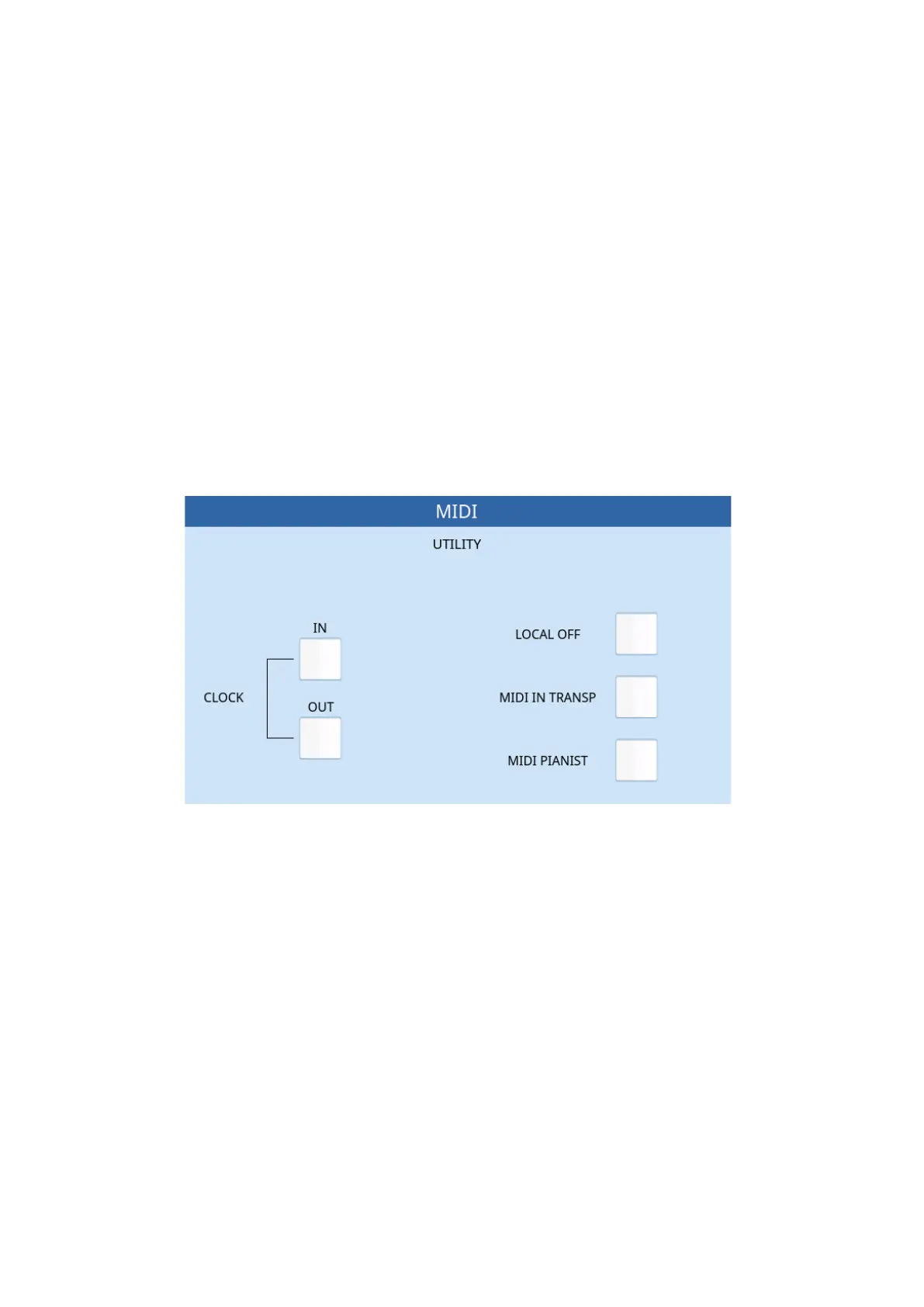
This page allows one to choose some general MIDI settings of the instrument:
• CLOCK: MIDI CLOCK is a useful message to synchronize different MIDI devices so
that they travel at the same time. You can separately enable the management of
these messages in real time:
• IN: When active, the instrument accepts Clock commands from external MIDI
devices.
• OUT: When active, the instrument transmits Clock commands to External MIDI
devices (Sequencer/Controller).
• LOCAL OFF: Enables the LOCAL CONTROL OFF function, i.e. the keyboard is
virtually disconnected and the sound generation module can only be managed
from the MIDI IN 1 input.
• MIDI IN TRANSP: Enables the receipt of pitch transposition commands from an
external MIDI device.
• MIDI PIANIST: Allows you to control EVM from a digital piano (or similar). It will
be possible to play the piano-style arranger section from the digital piano,



 To Next Page