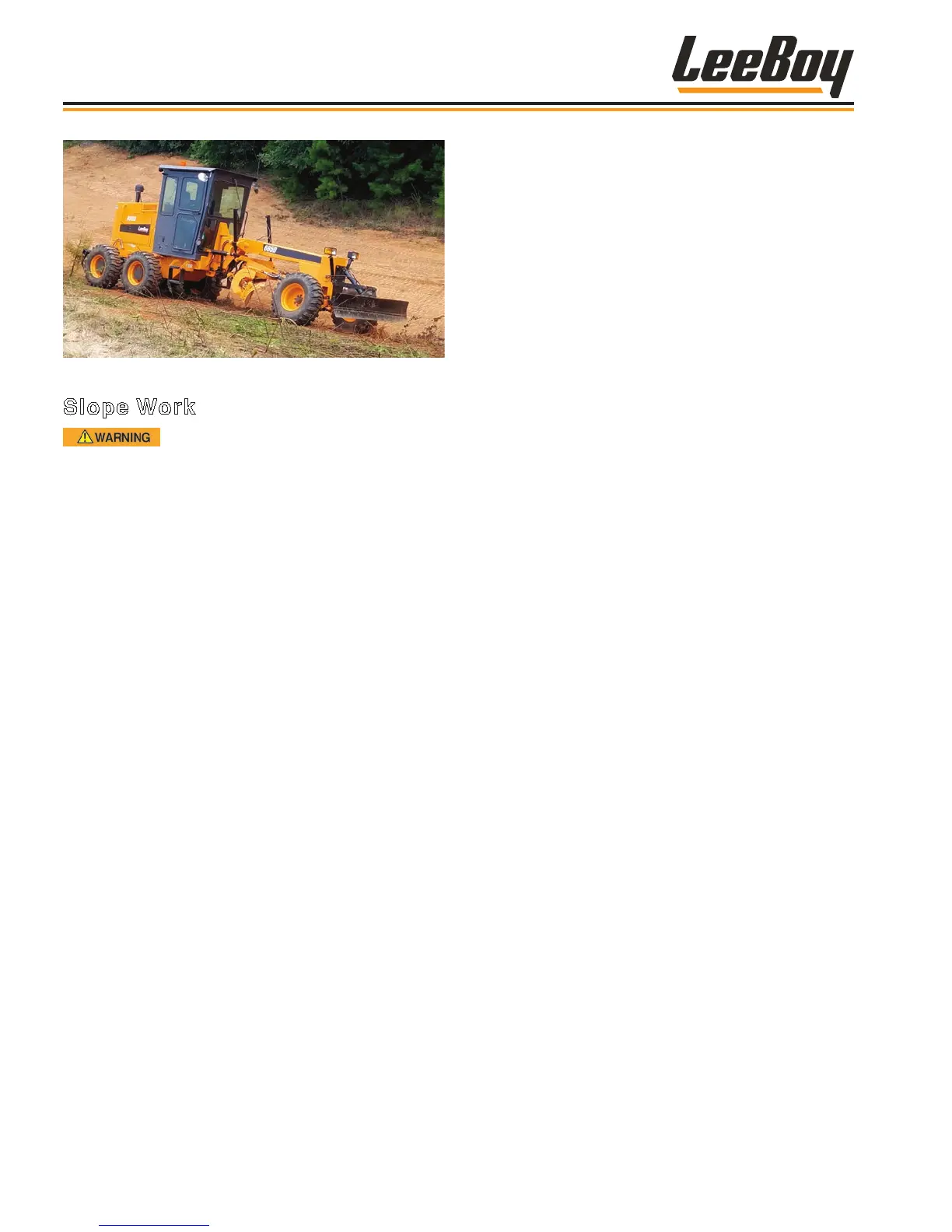
Figure 4-53. Slope Work
Slope Work
Use extreme caution and drive slowly
while working on slopes. While unlikely, the grader
can roll over and result in serious injury or even
death.
Operating the grader on slopes can be dangerous,
especially for inexperienced operators. Maneuvering
on or along steep slopes requires excellent operator
skills and experience.
The slope perpendicular to the machine’s direction of
travel is commonly known as “side sloping.” Typically
steep slopes require articulation to navigate, but ONLY
experienced operators familiar with the machine
should perform this type of work.
The slope parallel to the machine’s direction of travel
that affects the grader’s ability to travel up or down
terrain is known as gradeability. This is established
by the grader’s ability to stop without skidding the tire
while moving downhill. The grader can climb steeper
slopes than it can safely descend. If working on hills and
slopes, it is important to consider the following points:
• NEVER climb a slope steeper than you can safely
descend.
• At higher speeds, inertia forces make the grader less
stable. If you must work on a slope, work SLOWLY.
• Attachments can cause the grader to balance
differently. Ample allowance for the moldboard
and any other attachments should be made where
the terrain or surface is uneven to avoid damage to
attachments or injury from an unbalanced machine.
The position of the moldboard can affect the stability
of the grader considerably.
• New lls may give way with the grader’s weight while
rocky surfaces can cause side slipping.
• Position the moldboard toe outside and behind the
uphill wheel so the moldboard heel deposits material
outside the downhill tandem wheels.
• Excessive loads or side draft can also cause wheel
slippage as the downhill tires “dig in” and increase the
angle of the grader.
• Articulation and wheel lean angles also affect the
stability of the grader. Only experienced operators
should articulate when working on slopes.
• Lean the front wheel vertically and position the uphill
front wheel on the edge of the windrow created from
previous pass to provide extra stability and create an
even grade.
If possible, make a rst pass from above the slope to
establish the moldboard blade angle you will need.
Experienced grader operators can also use articulation
for added reach, ensuring the tandem wheels (rear) are
on a level surface.
1. Angle the toe of the moldboard outside and behind
the uphill wheel, with the moldboard heel downhill
outside the tandem wheels.
2. Tilt the moldboard forward slightly and make the rst
pass.
3. On the second pass, lean the front wheels toward
slope and slightly articulate rear wheels down slope
to increase machine stability.
4. Make as many passes as needed for the desired
result, then clean with the moldboard less angled
but tilted more forward away to clean any windrow
away from the bottom of the slope.
Operation
LeeBoy 685D Motor Grader4-32


 To Next Page