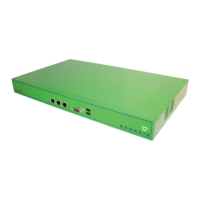
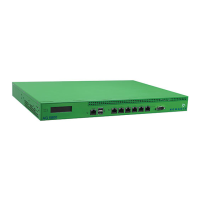
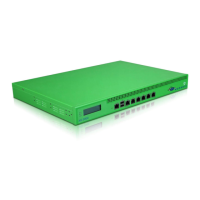
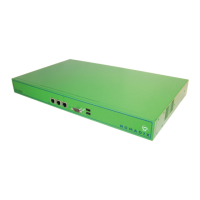
ACCESS GATEWAY
Installing the Access Gateway 39
Enter new system location: Office, Newbury Park, CA
Enter read/get community [public]:
Enter write/set community [private]:
Enter IP of trap recipient [0.0.0.0]: 10.11.12.13
SNMP Daemon: Enabled
System contact: newname@domainname.com
System location: Office, Newbury Park, CA
Get (read) community: public
Set (write) community: private
Trap recipient: 10.11.12.13
Reboot to enable new changes? [yes/no] y
Rebooting ...
You can now address the Access Gateway using an SNMP client manager.
Enabling the Logging Options (recommended)
System logging creates log files and error messages generated at the system level. AAA
logging creates activity log files for the AAA (Authentication, Authorization, and Accounting)
functions. You can enable either of these options.
When system logging is enabled, the standard SYSLOG protocol (UDP) is used to send all
message logs generated by the Access Gateway to the specified server.
1. Enter log (logging) at the Configuration menu. The system displays the current logging
status (enabled or disabled).
2. Enable or disable the system and/or AAA logging options, as required. If you enable
either option, go to Step 3, otherwise logging is disabled and you can terminate this
procedure.
3. Assign a valid ID number (0-7) to each server.
4. Enter the IP addresses to identify the location of the system and AAA SYSLOG servers on
the network (the default for both is 0.0.0.0).
When logging is enabled, log files and error messages are sent to these servers for future
retrieval. To see sample reports, go to “Sample SYSLOG Report” on page 264 and
“Sample AAA Log” on page 263.
Although the AAA and billing logs can go to the same server, we recommend that
they have their own unique server ID number assigned (between 0 and 7). When
managing multiple properties, the properties are identified in the log files by their
IP addresses.


 To Next Page