The music for each
of
these parts is shown
on
the
previous page. Once this has been accomplished, go
on
to
the next section
and
learn
how
to
merge
two
tracks together.
Merging
Tracks
By
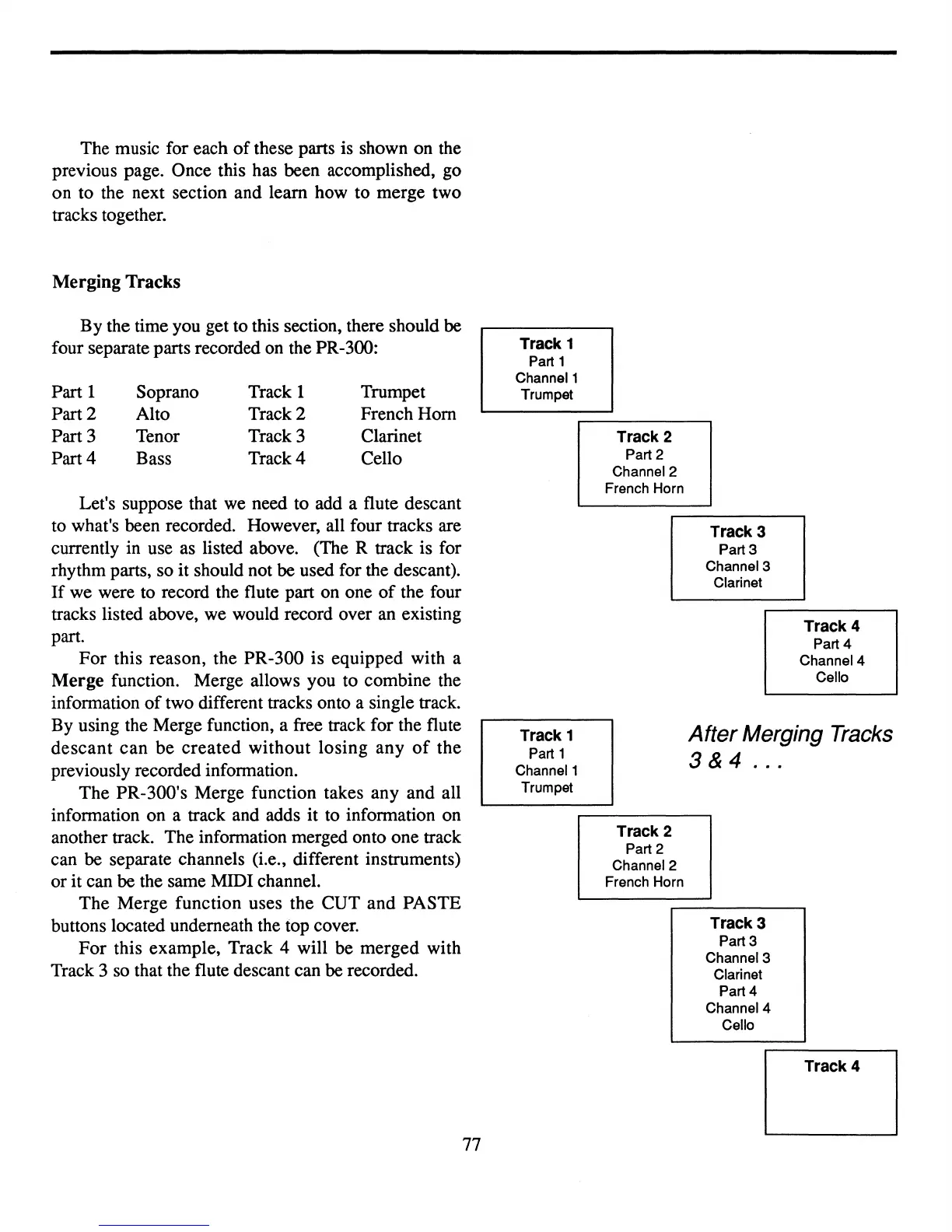
the time you get to this section, there should be
four separate parts recorded on the PR-300:
Let's suppose that we need to add a flute descant
to what's been recorded. However, all four tracks are
currently in use as listed above. (The R track is for
rhythm parts, so
it
should not be used for the descant).
If
we
were to record the flute part on one
of
the four
tracks listed above, we would record over an existing
part.
For
this
reason,
the
PR-300
is
equipped
with a
Merge
function. Merge allows you to
combine
the
information
of
two different tracks onto a single track.
By
using the Merge function, a free track for the flute
descant
can
be
created
without
losing
any
of
the
previously recorded infonnation.
The
PR-300's
Merge function takes
any
and
all
information
on
a track and adds
it
to infonnation on
another track. The information merged onto
one
track
can
be
separate channels (i.e., different instruments)
or
it can be the same MIDI channel.
The
Merge
function
uses
the
CUT
and
PASTE
buttons located underneath the top cover.
For
this
example,
Track 4 will be
merged
with
Track 3 so that the flute descant can be recorded.
Part 1
Part 2
Part
3
Part 4
Soprano
Alto
Tenor
Bass
Track 1
Track 2
Track 3
Track 4
Trumpet
French
Hom
Clarinet
Cello
77
Track 1
Part 1
Channel 1
Trumpet
Track 1
Part 1
Channel 1
Trumpet
Track 2
Part 2
Channel 2
French Horn
Track 2
Part 2
Channel 2
French Horn
Track 3
Part 3
Channel 3
Clarinet
Track 4
Part 4
Channel 4
Cello
After
Merging Tracks
3 & 4
...
Track 3
Part 3
Channel 3
Clarinet
Part 4
Channel 4
Cello
Track 4


 To Next Page