176 Forward Error Correction in IP Networks
CP560 DVB-T2 Gateway User’s Manual Rev. 2.2 (3686) ID: um_t2gateway
Figure C.3 shows this arrangement. Here, checksums are also calculated for the packets in each
row. This gives rise to another D FEC packets, which again means increased overhead.
A drawback with a rectangular matrix arrangement is that all column-FEC packets need to be
transmitted at nearly the same time as all column-FEC packets are generated when the last row
of the matrix is being completed. Thus when transmitting the last row of payload packets the
packet rate must be doubled in order to also send the FEC packets without generating extra
payload packet delay. In itself this may cause temporary network overload with packet loss as
a result. The specification [12] imposes some rules how FEC packets should be interleaved with
payload packets to avoid excessive jitter and ensuring compatibility between equipment from
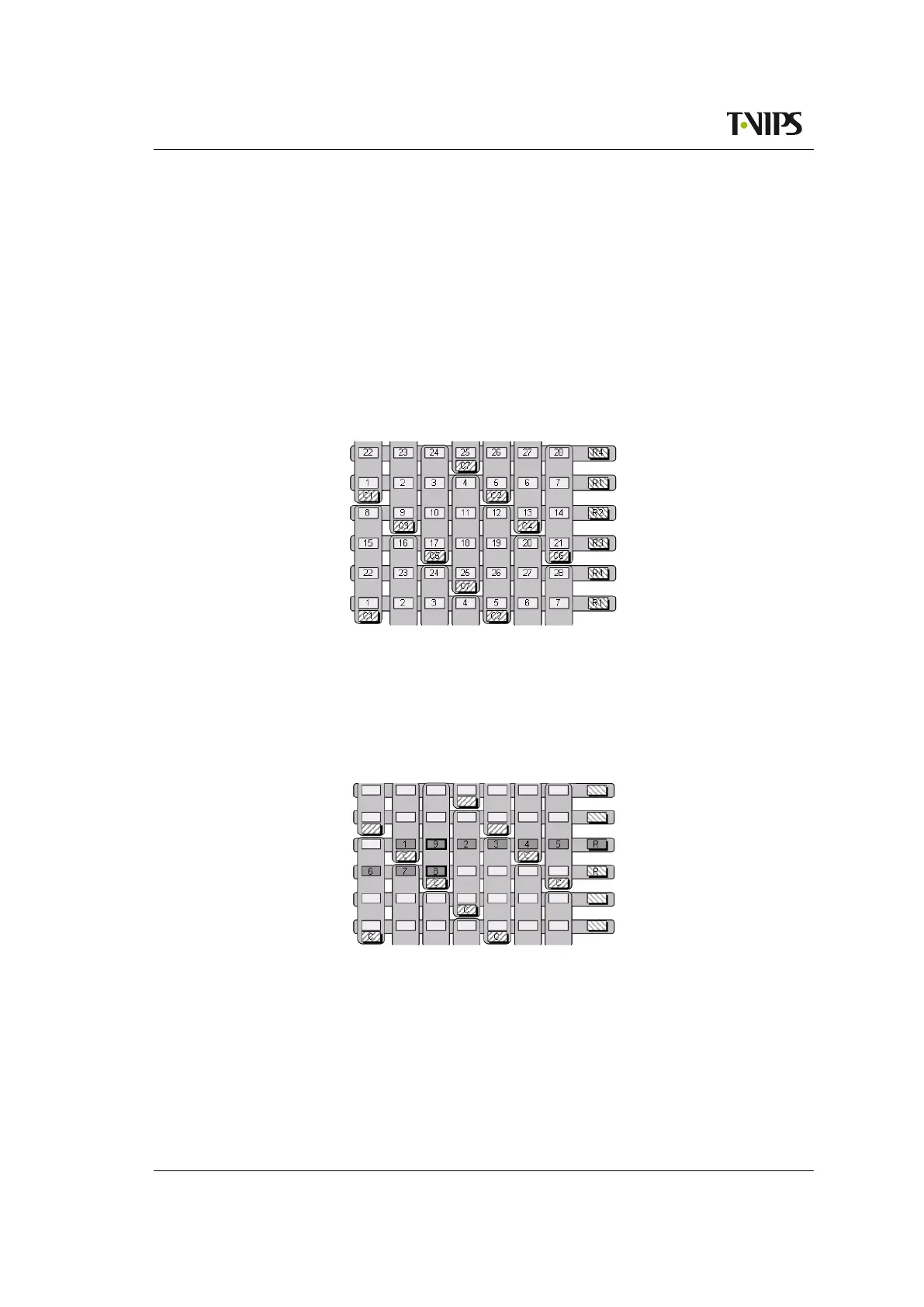
different manufacturers. One method is to offset the FEC columns, one example is shown in
Figure C.4, which also provides additional advantages.
Figure C.4 FEC matrix
with column offset
Column offset leads to column FEC packets being generated at a more regular rate and it is
possible to transmit packets with a shorter delay than with a rectangular matrix. Offsetting
the columns also increases the capability to regenerate longer bursts of lost packets; the length
depending on the column and row length ratio.
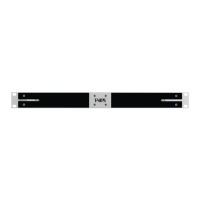
Figure C.5 Offset FEC matrix with miss-
ing packets
Figure C.5 shows an offset matrix with missing packets. The numbered items indicats packets
lost. The figure shows that column offset may increase the capability to correct longer bursts
of lost packets. In this example 9 consecutive packets are lost. Even if the row length is only
7 packets, all the 9 lost packets are reconstructed. The packets are numbered in the order they
can be recovered. Packets marked 8 and 9 are protected by the same column FEC packet and
are recovered by the row FEC packets after recovery of packets 1 through 7.


 To Next Page