3-44 Engine Electrical Industrial 1.6L
Spark Plugs
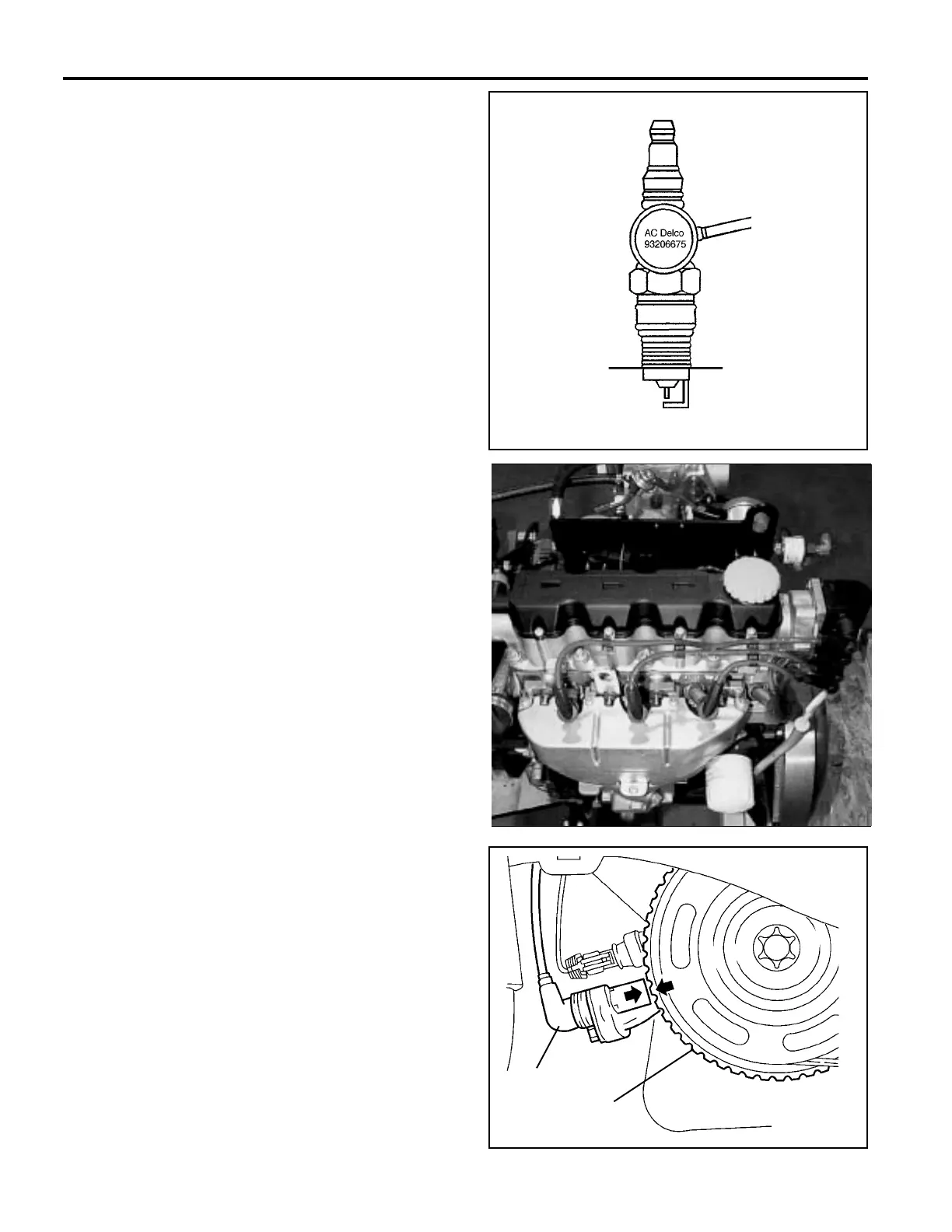
The 1.6 Liter engine uses resistor type spark plugs.
The plugs used in this engine have a tapered seat,
so a gasket is not required.
A spark plug must operate within certain temperature
limits to provide the performance and service life
expected. The plug selected for this engine is based
on the normal service for which the engine was
designed. Depending on operating conditions, the
spark plug heat range may have to be adjusted
upward or downward one range in order to match the
specific engine requirements.
Secondary Wiring
The secondary wires, often referred to as “spark plug
wires”, carry voltage between the ignition coil packs
and the spark plugs.
The secondary wiring used with the 1.6 Liter engine
is a carbon impregnated cord conductor encased in
an 8 mm (5/16-inch) diameter silicone rubber jacket.
The silicone wiring will withstand very high tempera-
tures and also provides an excellent insulator for the
higher voltages of a distributorless ignition system.
The secondary wire connections are covered with
rubber boots and form a tight seal to prevent arcing.
Notice: Because the secondary wires are designed
for a tight fit, always remove the wires by pulling on
the boot while exerting a gentle twisting action. This
will prevent damage to the wire connectors. Pulling
directly on the spark plug wires can damage them.
Crankshaft Position (CKP) Sensor
The crankshaft position (CKP) sensor is located at
the lower right front of the engine, near the crank-
shaft pulley.
The sensor works in conjunction with a 58 tooth
reluctor wheel on the crankshaft. The electronic
control unit (ECU) monitors the voltage from the CKP
sensor circuits.
As the reluctor wheel tooth passes past the sensor,
the sensor creates an analog voltage signal. This
analog signal is used by the ECU to properly syn-
chronize the fuel injectors and the ignition timing.
On some engine applications, this signal can also be
used to detect engine misfires.
80363008
Sensor
Reluctor Wheel
80363009
80363004



 To Next Page