Stratus OCT User Manual PN 2660021134133 A
Introduction
1-7
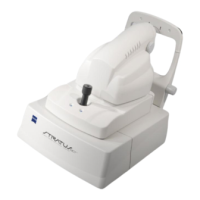
The Stratus OCT interferometer electronically detects, collects, processes and stores the
echo delay patterns from the retina. With each scan pass, the Stratus OCT captures from
128 to 768 longitudinal (axial) range samples, i.e., A-scans. Each A-scan consists of 1024
data points over 2 mm of depth. Thus the Stratus OCT integrates from 131,072 to 786,432
data points to construct a cross sectional image (tomogram) of retinal anatomy. It displays
the tomograms in real time using a false color scale that represents the degree of light
backscattering from tissues at different depths in the retina. The system stores the scans
you select for later analysis.
How It Works for You
The Stratus OCT delineates intraretinal, cross-sectional anatomy with axial resolution of
10 micrometers and transverse resolution of 20 micrometers. The Stratus OCT software
package includes scan acquisition protocols and analysis protocols. Together they enable
you to analyze the optic disc, retinal nerve fiber layer and the macula with a single
instrument. The Stratus OCT facilitates the evaluation of both glaucoma and vitreoretinal
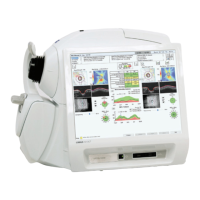
disease. The Stratus OCT video camera enables you to view the patient's fundus as you
work, and to store video and scan images together. The data management system enables
you to keep Stratus OCT histories, so you can monitor patients over time. The inkjet printer
enables you to generate color hard copy.


 To Next Page