Acquire Scans
Stratus OCT User Manual PN 2660021134133 A
3-6
ocular lens and positioning further. All the while, use the live video image to observe the
position and focus with respect to the study eye. (While not usually necessary, adjustments
to the video image are possible—see
Video and Lamp Parameter Tab, page 3-18,
for instructions.)
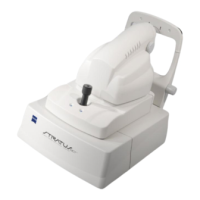
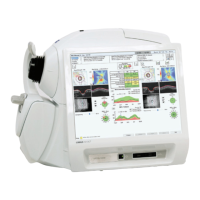
1. At the outset, focus on the study eye from a distance before moving the patient
module. Instruct the patient to look straight ahead. Then press the joystick button to
unlock the patient module and move it toward the study eye. Place it so that the
ocular lens is approximately 25 mm (one inch) from the study eye.
2. Manipulate the joystick—move for lateral adjustments and twist for vertical
adjustments—to center the video image on the pupil. Then, using the joystick, gently
push the patient module toward the eye so the video image moves through the pupil
and the fundus comes into view.
3. Instruct the patient to look at the green target light. With the joystick, carefully
continue to push the patient module toward the eye and make vertical adjustments
until the Stratus OCT beeps, which is a signal that the patient module is the correct
distance from the eye for scanning. It beeps when it begins to acquire a retinal scan
image, which is visible as a band of contrasting color (green, yellow, red) against the
blue background noise on the monitor.
4. Instruct the patient to continue to fixate on the green target light. If necessary, further
adjust the patient module position from side to side, up and down, until the retinal
image fills the screen and is evenly illuminated. Shadows from the edge of the pupil
should be eliminated, if possible, for best scanning results. Press the joystick button
to lock the patient module in place.
While the patient module is locked, you can still adjust the focus and twist the joystick to
adjust height. With experience, you may find that you have condensed steps 2 through 4
into one continuous step.
Note: It is not necessary to spend a long time trying to get the best possible view of
the fundus. It is more important to have a strong scan image signal than an
excellent fundus video image.
Optimize Scan Image
To optimize the scan image requires two steps: adjust Z-offset and optimize polarization.
The goal of optimizing the scan image is to yield the strongest scan signal, and thus the
best scan image. Better images are more defined, and have more red and yellow color.
• You can also optimize the scan image by making slight adjustments to the focus
and/or to the three-dimensional positioning of the patient module.
Adjust Z-offset
In the usual course of a scan, the first thing you do after positioning is adjust the Z-offset
(axial position) of the scan. The axial length of the Stratus OCT scan image is 2 mm while
the eye length is 10-fold larger. So, if the axial range is not correct, the retina is not


 To Next Page