Introduction
Stratus OCT User Manual PN 2660021134133 A
1-6
Organization of The Manual
This introductory chapter provides a system description, installation and safety information.
Chapters
(2) through (6) are organized according to the normal sequence of operation of
the Stratus OCT, followed by data management and data transfer functions in Chapters (7)
through (9), as follows:
• Prepare To Scan, explained in Chapter (2).
• Acquire Scans, explained in Chapter (3).
• Scan Acquisition Protocols, described in Chapter (4).
• Analyze Scans, explained in Chapter (5).
• Analysis Protocols, described in Chapter (6).
• Data Management, explained in Chapter (7).
• Archive, Retrieve & Backup, explained in Chapter (8).
• Export and Import Scan Data, explained in Chapter (9).
Chapters (10), (11) and (12) cover Routine Maintenance, instrument Specifications
and Legal Notices, respectively. Users who wish to use the Stratus OCT in a networked
environment should see Networking Guidelines.
Stratus OCT System Described
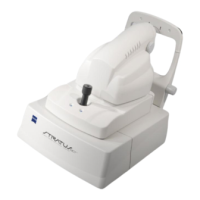
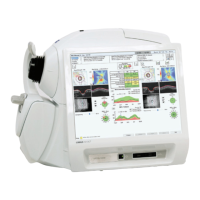
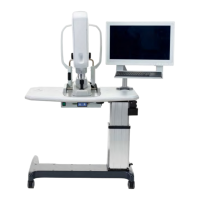
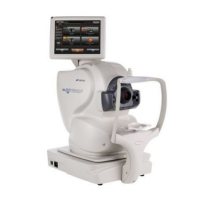
The Stratus OCT is a computer-assisted precision optical instrument that generates cross
sectional images (tomograms) of the retina with
10 micrometers axial resolution. It works
by using an optical measurement technique known as low-coherence interferometry.
How The Stratus OCT Works
The principle of operation of interferometry is analogous to ultrasound, except that it uses
light rather than sound. The difference permits measurement of structures and distances
on the
10 micrometer scale, versus the 100-micrometer scale for ultrasound. Another
important difference is that optical interferometry does not require contact with the tissue
examined, unlike ultrasound.
The Stratus OCT contains an interferometer that resolves retinal structures by measuring
the echo delay time of light that is reflected and backscattered from different
microstructural features in the retina. The Stratus OCT projects a broad bandwidth
near-infrared light beam (820 nm) onto the retina from a super luminescent diode. It then
compares the echo time delays of light reflected from the retina with the echo time delays
of the same light beam reflected from a reference mirror at known distances. When the
Stratus OCT interferometer combines the reflected light pulses from the retina and
reference mirror, a phenomenon known as interference occurs. A photodetector detects
and measures interference. Although the light reflected from the retina consists of multiple
echoes, the distance traveled by various echoes is determined by varying the distance to
the reference mirror. This produces a range of time delays of the reference light for
comparison.


 To Next Page