2-8
Safety notes
X6 - P/N 6525032M1
Fig.2-7
Check your equipment
Check your tractor before beginning your workday. Make
sure that all systems are correctly operating.
WARNING: personal safety devices must be worn for
each check and maintenance operation.
•
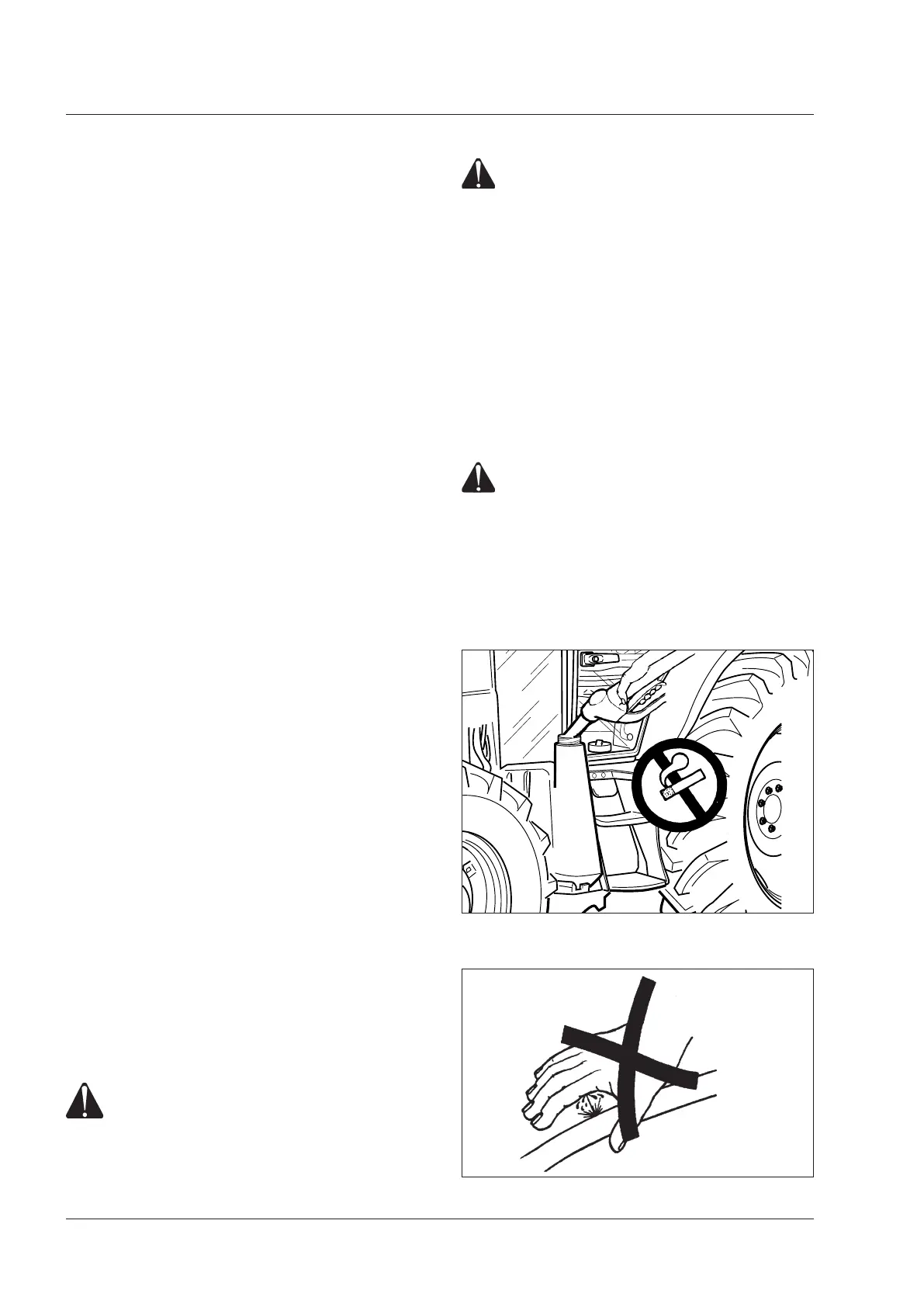
DO NOT smoke while filling the fuel tank. Keep any
type of open flame away (Fig.2-7).[4.1.l]
•
Check for loose, broken, lost or damaged parts. Make
sure that all safety devices are in place.
•
Check safety frame and seat belt for damage. A dam-
aged safety frame or seat belt MUST be replaced.
•
Ensure that implements and attachments are properly
installed and that the tractor and implement PTO RPM
ratings match.
•
Check the tyres for cuts, bulges and correct pressure.
Replace worn or damaged tyres.
•
Check foot and parking brakes for proper operation.
Adjust if required.
•
Before filling up the tank, turn the engine off and wait
for it to cool down.
•
Check the engine oil level and top up if required.
•
Carry out all maintenance and adjustment operations
described in the proper section of this manual.
•
Check that the PTO drive locking devices are latched.
•
Check that the tractor PTO shield and driveline guards
are in place and operating properly.
•
Check the tractor and implement hydraulic system.
Have any leaks or damaged parts repaired or renewed.
•
HYDRODYNAMIC SYSTEMS: HOSES Hoses are an
important component in modern machines. Hoses
can change their characteristics in the course of time
because of pressure, vibrations, weather etc. Laws
in force prescribe that hoses are replaced within 6
years from their construction. WE RECOMMEND
COMPLIANCE WITH THIS RULE. [4.1.i]
WARNING: When using the auxiliary control
valves, quick couplings may reach high tem-
peratures. Therefore it is mandatory to use
suitable safety gloves when hitching or unhitch-
ing implements connected to these couplings.
Fig. 2-8
WARNING: Diesel fuel or hydraulic fluid under
pressure can pierce the skin or eyes and cause
serious personal injury, blindness or death.
Fluid leaks under pressure may not be visible.
Use a piece of cardboard or wood to find leaks.
Never use your bare hand. Wear safety goggles
for eye protection. If any fluid is injected into
the skin, it MUST be surgically removed within
a few hours by a doctor familiar with this type
of injury (Fig.2-8).
Before applying pressure to the fuel or hydraulic system,
be sure all connections are tight and that lines, pipes,
and hoses are not damaged. Before disconnecting fuel
or hydraulic lines, be sure to relieve all pressure.
Make sure that all hydraulic lines are correctly installed
and not crossed or tangled
WARNING: Liquid cooling systems build up
pressure as the engine gets hot. Before remov-
ing the radiator cap, stop the engine and let
the system cool.



 To Next Page