2-14
Safety notes
X6 - P/N 6525032M1
Risk of overturning
For your safety, it is mandatory that all footstep tractors
are fitted with original Roll Over Protective Structures
and seat belts.
In the event of overturning with a tractor fitted with a cab
or ROPS, hold the steering wheel firmly and DO NOT at-
tempt to leave the seat until the tractor has come to rest.
If the doors are locked, leave the tractor through the duly
indicated emergency exits (Fig.2-18).
IMPORTANT: The safe working practices listed hereunder
concerns only a few cases of overturning risk. The list is
therefore NOT comprehensive of all possible cases.
CAUTIONS to avoid side overturning
•
Adjust the wheels to the maximum possible track
width for the type of work you are doing.
•
Lock both brake pedals together before driving on
road.
•
Reduce your speed according to work conditions.
If the tractor is equipped with a front-end loader, carry
the bucket and load as low as possible.
•
Reduce your speed before making wide turns.
•
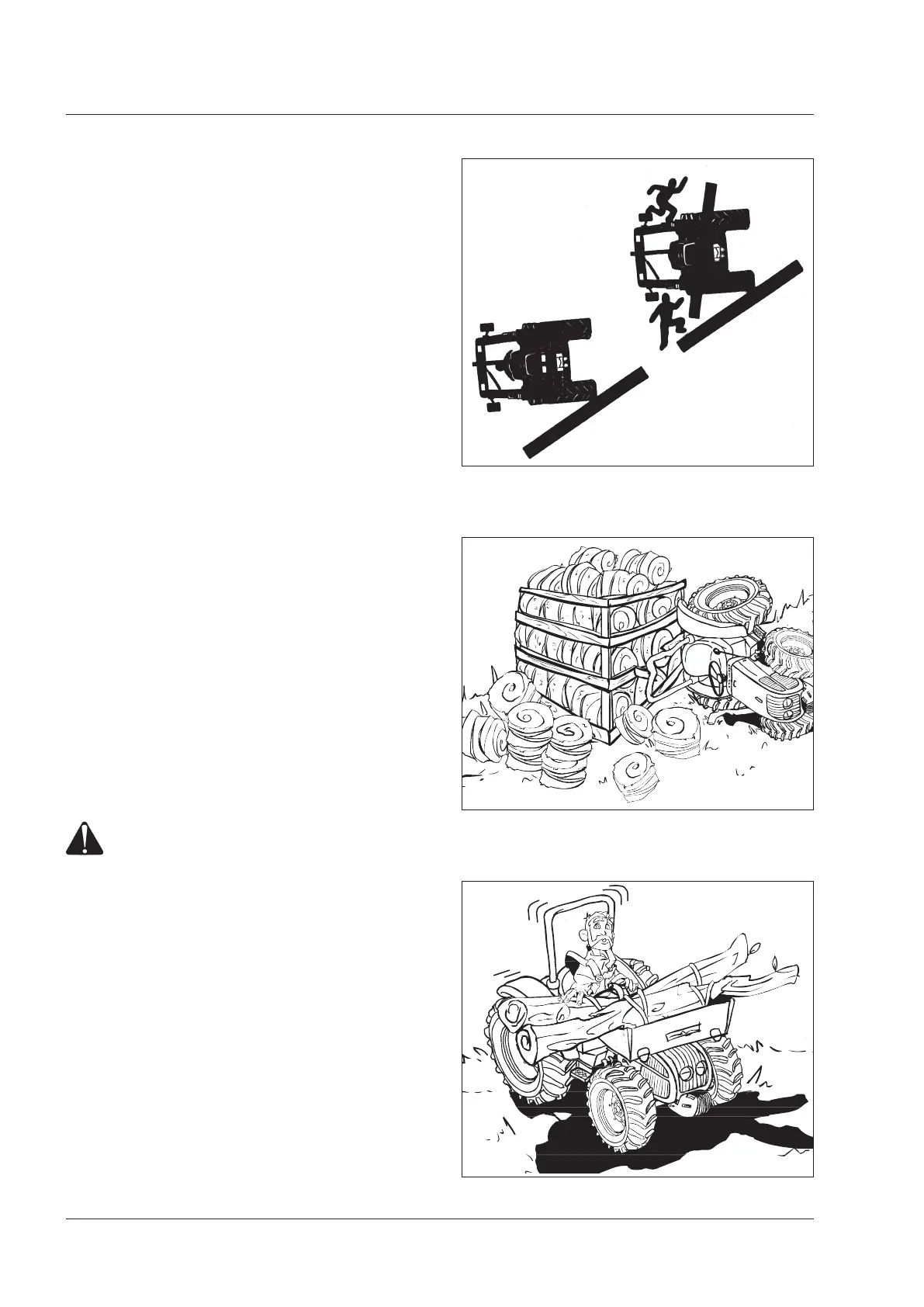
DON'T pull a load too heavy for your tractor. It could
run away on the down slope or the tractor could
jack-knife around a towed load (Fig.2-19)
•
DON'T brake suddenly. Apply brakes smoothly and
gradually.
•
When going down a slope use the throttle to slow
the tractor engine and use the same gear you would
use to up the slope. Shift into gear before you start
downhill.
•
Engage four-wheel drive (if equipped); this will give
greater stability.
WARNING: NEVER disengage the clutch or
attempt to shift gear after you have started
downhill.
•
Always go up and down slopes following a straight
upward or downward line.
•
Do not put any overloads on a front implement or a
trailer. Use suitable counter-weights to keep the tractor
stable.(Fig.2-20)
•
NEVER use your tractor to round up farm animals.
Fig.2-18
Fig.2-19
Fig.2-20



 To Next Page