Maintenance
7-91
7
P/N 6525032M1 - X6
Air bleeding from the rear brake
system
It becomes necessary to bleed the circuit when air enters
owing to lack of oil in the relative reservoir or when the
braking system is serviced.
This operation should be carried out by specialised per-
sonnel. If, however, you decide to do it yourself, carefully
follow the steps described here.
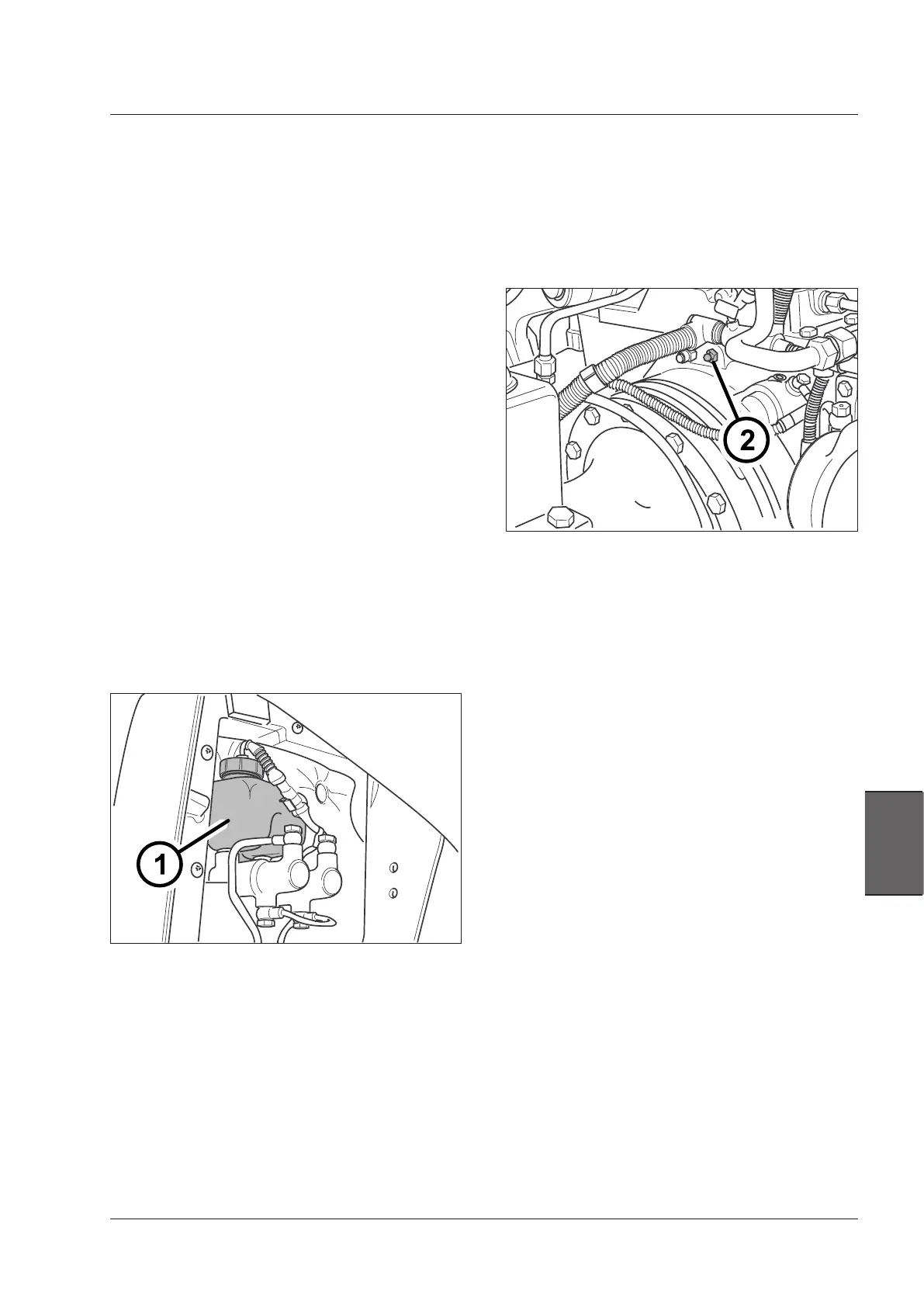
1 - Make sure that the reservoir (1 - Fig.7-22) is full.
2 - Thoroughly clean the area around the bleed screw.
3 - Depress the left-hand brake pedal completely.
Meanwhile, unscrew the bleed screw (2 - Fig.7-23)
a half-turn and allow any air and oil to flow out. Re-
tighten the bleed screw and release the pedal.
4 - Repeat this operation until bubble-free oil flows from
the bleed screw.
5 - Check to make sure that the pedal travel has returned
to normal and is not spongy.
6 - Carry out the operations described above for the left-
hand side of the braking circuit.
7 - On completion of bleeding, top up the fluid level in
the reservoir (1 - Fig.7-22).
Fig.7-22 - Brake fluid reservoir (1)
NOTE: Never reuse previously bled oil without having
first filtered it.
IMPORTANT: Dispose of oil in accordance with local
law requirements. DO NOT drain oil on the ground, into a
drain or into a container that can leak. Be responsible for
the environment.
GENERAL MAINTENANCE
WARNING: If you need to open the bonnet, follow the procedure indicated under "How to open the bonnet".
WARNING: Always use the specific PPE for the operation concerned.
WARNING: Beware of burns caused by hot tractor and engine parts. [4.1.n]
Fig.7-23 Air bleeding from the rear brake system.
2 - Bleeder screw.
WARNING: when replacing and refilling oil into the
brake system (1-Fig.7-22), take care that these ma-
chines use a mineral base oil. Refer to the Lubricants
and Fuels chart for oil type. Never mix or exchange
these two types of brake fluid as this could rapidly
bring about brake failure.
WARNING: The oil in the brake circuits has been
studied to operate at a temperature of 100°C, but only
if not polluted by other substances, e.g. water that, if
in considerable quantities, will turn into vapour and
prevent the braking system from operating in the cor-
rect way. Take the necessary precautions to prevent
water from penetrating into the system: protect the
front axle and the components in the braking system
when the tractor is washed; store oil in sheltered
places where water cannot infiltrate. If you think
that there is water in the braking system you must
contact your dealer's specialised personnel and have
it removed. In this case, the rear brake cylinders will
have to be demounted and emptied and particularly
the brake housing of the front axle which, being the
lowest part of the system, is the one most exposed to
this type of fault.



 To Next Page