!
Biodex Medical Systems, Inc. © 2016 233
The following factors can affect measurement accuracy and should be taken into consideration
when using the Atomlab Dose Calibrator:
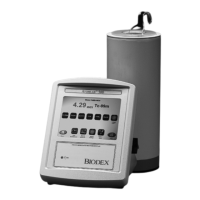
Lead Shield: A lead shield is necessary to protect personnel from exposure to the radiation
produced by radioactive isotopes. This lead shield is integrally installed as part of the Atomlab
dose calibrator. However, photon backscatter occurs from the lead shield, resulting in increased
detector sensitivity in the 88-200 keV photon energy range. This increase in sensitivity is already
included in the sensitivity curve above, and it can be easily seen in the peak at 88 keV. However, if
for any reason the dose calibrator is operated without the integral shield installed, the sensitivity
curve will be incorrect in this energy range, resulting in incorrect measurements for isotopes
which emit photons in this range. It is recommended that the dose calibrator always be operated
with the lead shield in place.
Radioisotope container: the style and type of container a radioisotope is in can effect the
measurement. Users should have a standard procedure, container, and solution volume for
measuring radioisotopes. Plastic syringes are often used as a standard container as they are
usually the means of delivery to the patient in a clinical environment. The dial values generated
using the photon sensitivity curve above should be appropriate for most plastic and thin glass
syringes. Glass vials may require a correction factor for some isotopes.
The wall thickness of the container is especially important when measuring isotopes which emit
low energy photon and/or high energy Beta radiation. I-125, I-123, and Xe-133 are especially
susceptible to errors caused by low energy photon absorption. In cases where a container has a
wall thickness or material significantly different from the NIST standards used above, it is
recommended that a correction factor or corrected dial value be used to correct for the difference
in absorption between the NIST configuration and the configuration used in clinical practice.
Whichever container and configuration is used in clinical practice, it is strongly recommended that
such configuration be standardized and used every single time.
Determining Your Own Dial Values
Dial values can be determined by the user for isotopes for which no published dial value exists. In
order to do this, you will need a sample for which the activity value is known. The activity value
may be provided by the isotope producer or pharmacy, or it may be measured by a
method independent of the dose calibrator. The accuracy of the dial value will depend upon the
accuracy of the known activity value of the sample used; because of this, it is best if an estimate of
the accuracy of the isotope calibration is available.
To determine the dial value for the isotope, select the Co-60 isotope key and measure the
isotope sample in the same container and geometry which will be used to measure the isotope in
clinical practice. The dial value can then be calculated by the following formula:
New Dial value = 5.0 x
activity
measurement
where the activity is the known activity of the source and the measurement is the displayed
activity when measured on the Co-60 isotope key. Remember to decay correct the source’s
activity for time elapsed since source activity calibration.


 To Next Page