!
152 ATOMLAB 500 DOSE CALIBRATOR
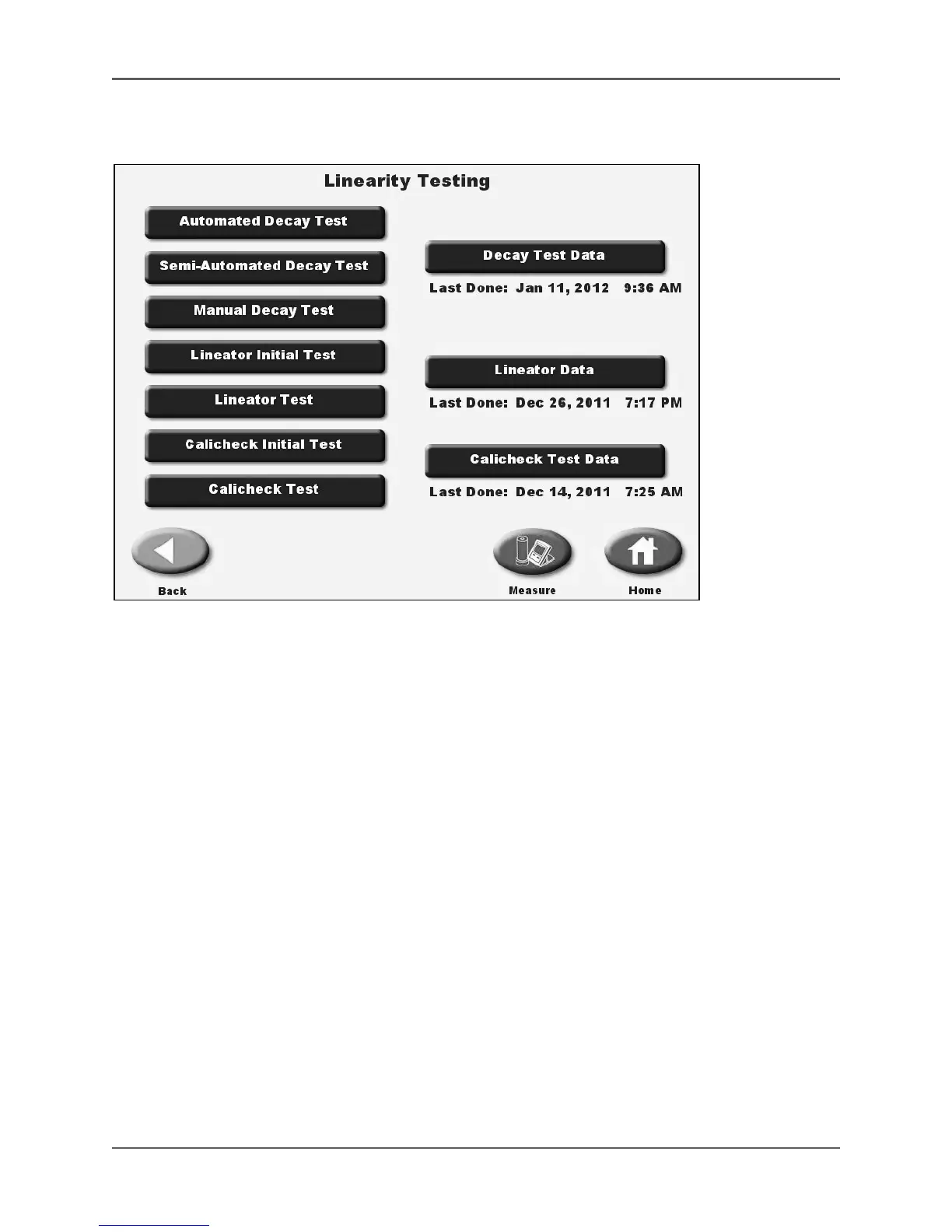
Linearity Testing
(See Figure 6.22)
Figure 6.22. The Linearity Testing screen.
The linearity test is used on a dose calibrator to determine the variation in the displayed
activity values from the true values, over a linear range of proportional source activities.
This test is usually performed using a vial or syringe of Tc-99m whose activity is at least as
large as the maximum activity normally assayed in a prepared radiopharmaceutical kit, in a unit
dosage syringe, or in a nuclearpharmaceutical therapy, whichever is largest.
Linearity means the proportionality of the measurement results to the activity measured, as
determined over the intended range of use for the dose calibrator.
NOTE: Other Isotopes such as F-18 can be used to perform linearity testing.
There are several acceptable methods for performing linearity testing. The differences in these
methods are all acceptable for determining the normalized value.
1. Decay correct the test sample from the first reading and compare each reading to the decay
corrected reading.
2. For Tc-99m select 30 hours as the normalized reading, and decay correct this reading to
calculate the expected activities at the times you took your readings. Compare the readings
to the calculated activities. You can change from 30 hours to another time point and
perform your normalized calculation from that time point. The Atomlab 500 automated
linearity test uses 30 hours as the default method.


 To Next Page