info@biopac.com
support@biopac.com
www.biopac.com
BIOPAC Hardware | Blood Pressure Cuff | Page 1 - 4 Updated: 3.28.2013
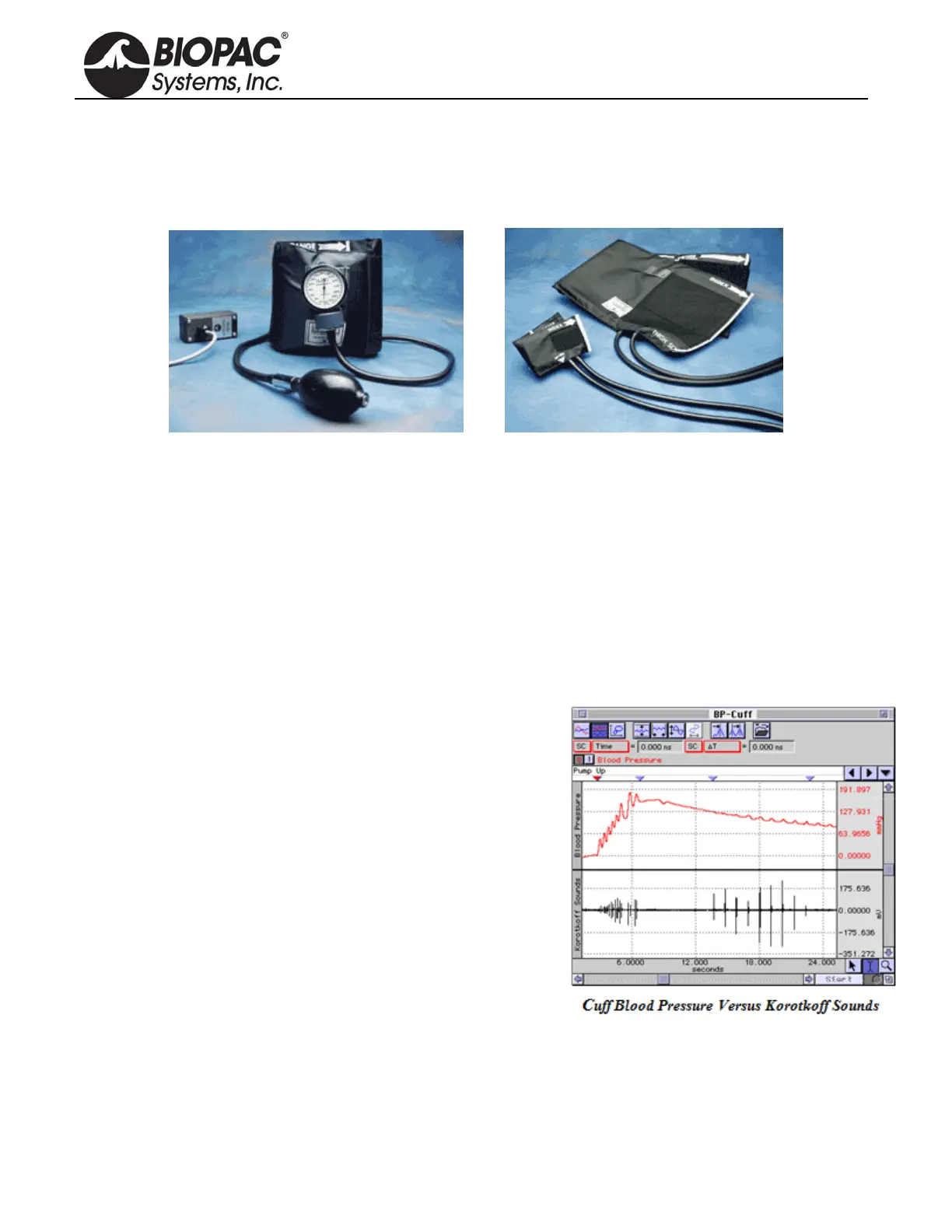
BLOOD PRESSURE CUFF AND TRANSDUCER
TSD120 for MP150/MP100 System
RX120 Series Cuff for TSD120
SS19L/LA for MP3x & MP45 System
TSD120 RX120A and RX120F cuff options
BLOOD PRESSURE MEASUREMENT
The most common form of indirect blood pressure measurement employs a pressure cuff, pump and pressure
transducer. This complete
assembly is commonly referred to as a sphygmomanometer.
Typically, the cuff is wrapped around the upper arm and is inflated to a pressure exceeding that of the brachial
artery. This amount of pressure collapses the artery and stops the flow of blood to the arm. The pressure of the
cuff is slowly reduced as the pressure transducer monitors the pressure in the cuff. As the pressure drops, it will
eventually match the systolic (peak) arterial pressure. At this point, the blood is able to “squirt” through the
brachial artery. This squirting results in turbulence that creates the Korotkoff sounds. The cuff pressure continues
to drop, and the pressure eventually matches the diastolic pressure of the artery. At that point, the Korotkoff
sounds stop completely, because the blood is now flowing unrestricted through the artery.
SETUP
The graph at right illustrates a typical recording using the
TSD120/SS19L.
TSD120: Pressure signal is recorded via a DA100C
amplifier set to DC, 10Hz LP and a gain of 200.
SS19L/LA: To record the pressure signal, Select SS19L/LA
preset from the MP3x/MP4x > Set Up Channels menu.
RECO
RDING
As the cuff is wrapped around the upper arm of the subject, be sure
to place the physiological sounds transducer underneath the blood
pressure cuff, directly over the brachial artery. Transducer
placement is very important to get the best possible recordings of
Korotkoff sounds. Finish wrapping the cuff around the upper arm
and secure it with the Velcro
®
seal. Now, start inflating the cuff with
the pump bulb.
The pressure trace shows the hand pump driving the cuff pressure up to about 150 mmHg. Then the cuff pressure
is slowly released by adjusting the pump bulb deflation orifice. Notice that the Korotkoff sounds begin appearing
when the cuff pressure drops to about 125 mmHg (bottom trace). As the pressure continues to drop, the Korotkoff
sounds eventually disappear, at about 85 mmHg. The systolic pressure would be identified at 125 mmHg and the
diastolic pressure would be 85 mmHg.


 To Next Page