info@biopac.com
support@biopac.com
www.biopac.com
BIOPAC Hardware | Gonio-Torsio | Page 5 - 9
Updated: 11.21.2013
OVERVIEW OF THE BIOPAC GONIOMETER SERIES
As with all measuring equipment, to correctly interpret the data, understanding the working principles (i.e., what the
sensor measures) before use is helpful. BIOPAC Systems, Inc. manufactures three types of sensors:
1.
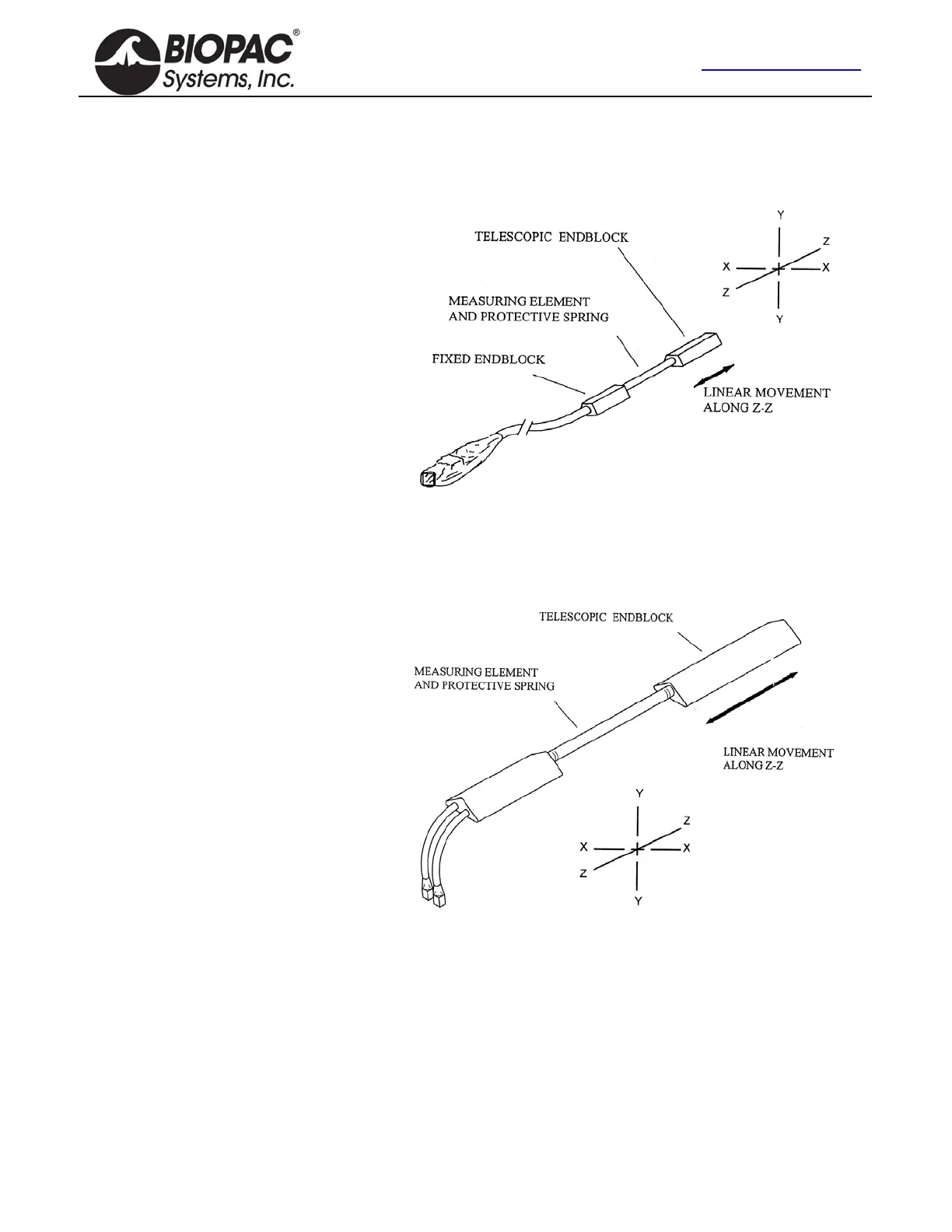
The single axis finger goniometer
permits the measurement of angles in
one plane.
Angles are measured when rotating one
endblock relative to the other about axis
X-X.
The goniometer is not designed to
measure rotations about Y-Y. Any
attempt to bend the unit in this way
more than ± 20 from the neutral position
will result in a reduction of the life of
the unit or failure.
The goniometer does not measure rotations about axis Z-Z,
though this movement is permitted without reduced life or
damage occurring. This goniometer is designed primarily for
the measurement of finger and toe flexion/extension.
2.
The twin axis goniometers permit the
simultaneous measurement of angles in
two planes, e.g. wrist flexion / extension
and radial / ulnar deviation. Rotation of
one endblock relative to the other about
axis X-X is measured using the gray
plug. Similarly, rotation of one
endblock relative to the other about axis
Y-Y is measured using the blue marked
plug.
Assuming the goniometer is mounted correctly (as outlined here), the outputs of the two channels are
independent of linear displacements along axis Z-Z.
It should be noted that rotation of one endblock relative to the other around axis Z-Z cannot be measured.
These goniometers function in the same way, and differ only in size.


 To Next Page