298
Trim and Tilt
Electrical Circuit Tests
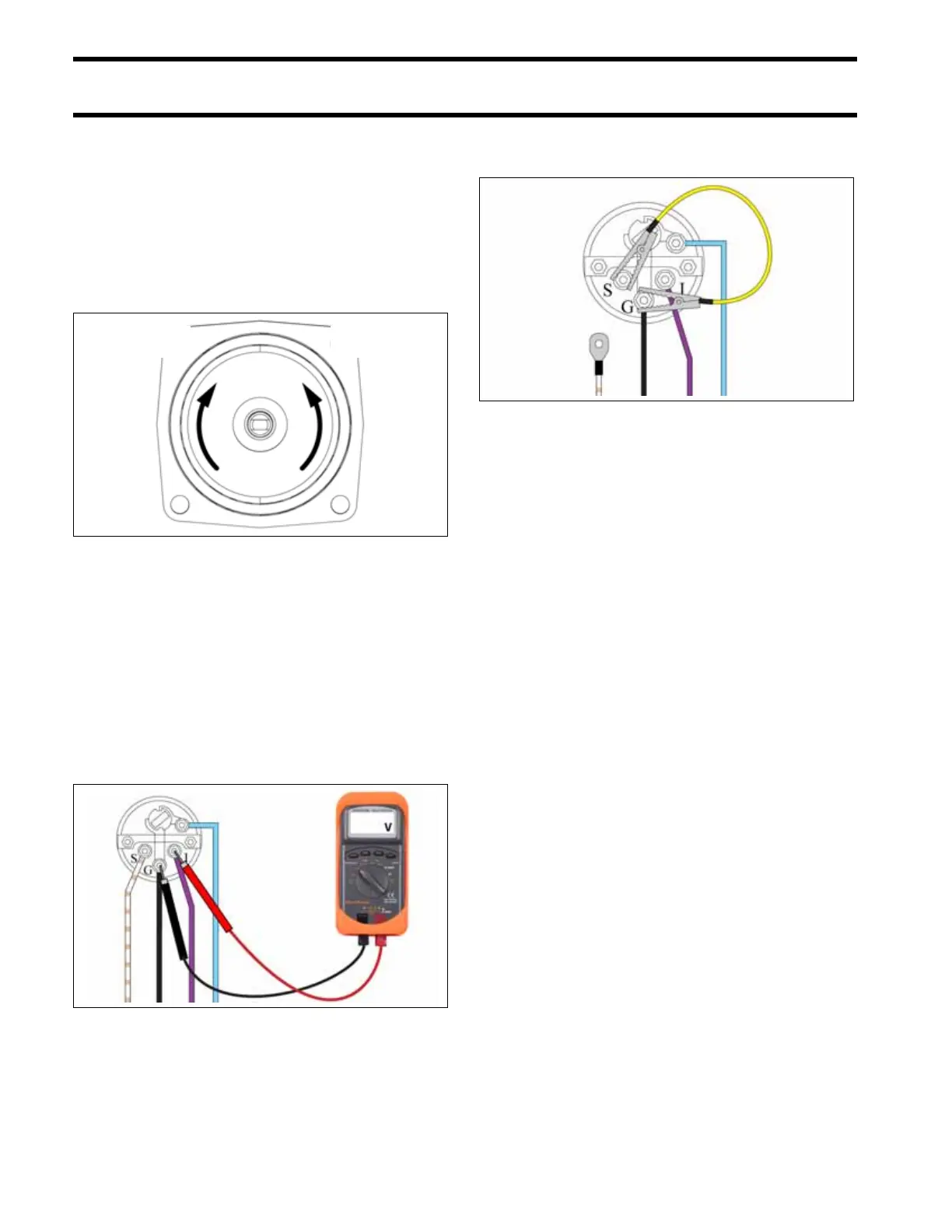
The motor shaft must rotate clockwise, as viewed
from the pump end, when positive (+) is applied to
the blue lead, and negative (–) is connected to
green lead.
The motor shaft must rotate counterclockwise, as
viewed from the pump end, when positive (+) is
applied to the green lead, and negative (–) is
applied to the blue lead.
If test results vary, replace the motor.
Trim Gauge Test
1. Turn key switch ON. Using a voltmeter, check
for voltage between the trim gauge “I” and “G”
terminals.
• If no voltage, check condition of instrument har-
ness, key switch, and engine 20 A fuse.
• If voltage is shown, go to STEP 2.
2. Remove the white/tan lead from the trim gauge
“S” terminal. With key switch ON, gauge should
indicate full-trim DOWN position. Now connect
a jumper wire between terminals “S” and “G.”
Gauge should indicate full-trim UP position.
• If results are different, replace the trim gauge.
• If results agree, refer to Trim Sender Test.
Trim Sender Test
IMPORTANT: To avoid immediate meter dam-
age, never apply an ohmmeter to an electrical cir-
cuit where voltage is present.
Disconnect the 3-pin connector between the
instrument harness and engine trim harness.
Connect an ohmmeter between the white/tan wire,
terminal “C,” of the engine harness and a clean
engine ground.
With the outboard fully DOWN, meter must show
a reading above 80 ohms.
With the outboard fully UP, meter must show a
reading below 10 ohms.
• If results agree, refer to Trim Gauge Test on
p. 298.
010328
010329
Green lead (+)
Blue lead (-)
Blue lead (+)
Green lead (-)
010330





 To Next Page