6-18
percent indicates that all notes are moved so that they are in perfect
time, while a strength of 50 percent means that all notes are moved half-
way towards the desired position. This lets you Òtighten upÓ the timing
as much as you want, without going too far.
The Groove Quantize command also lets you control the strength of
duration and velocity adjustments. As you work with this command, you
will notice that the note start time has a greater effect than the duration
on the rhythmic feel of the track. For this reason, changing the starting
times (time strength close to 100 percent) has a more noticeable effect
than changing durations (duration strength close to 100 percent).
However, there are situations in which you might want to change both to
avoid ending up with notes that overlap or with unwanted rests.
Swing
Many songs do not have notes positioned on a perfectly even time grid.
For example, songs with a swing feel, though they may be written
entirely in eighth notes, are often played more like eighth-note triplets,
with the Þrst note extended and the second one shortened. The swing
option lets you distort the timing grid so each pair of notes is spaced
unevenly, giving the quantized material a swing feel.
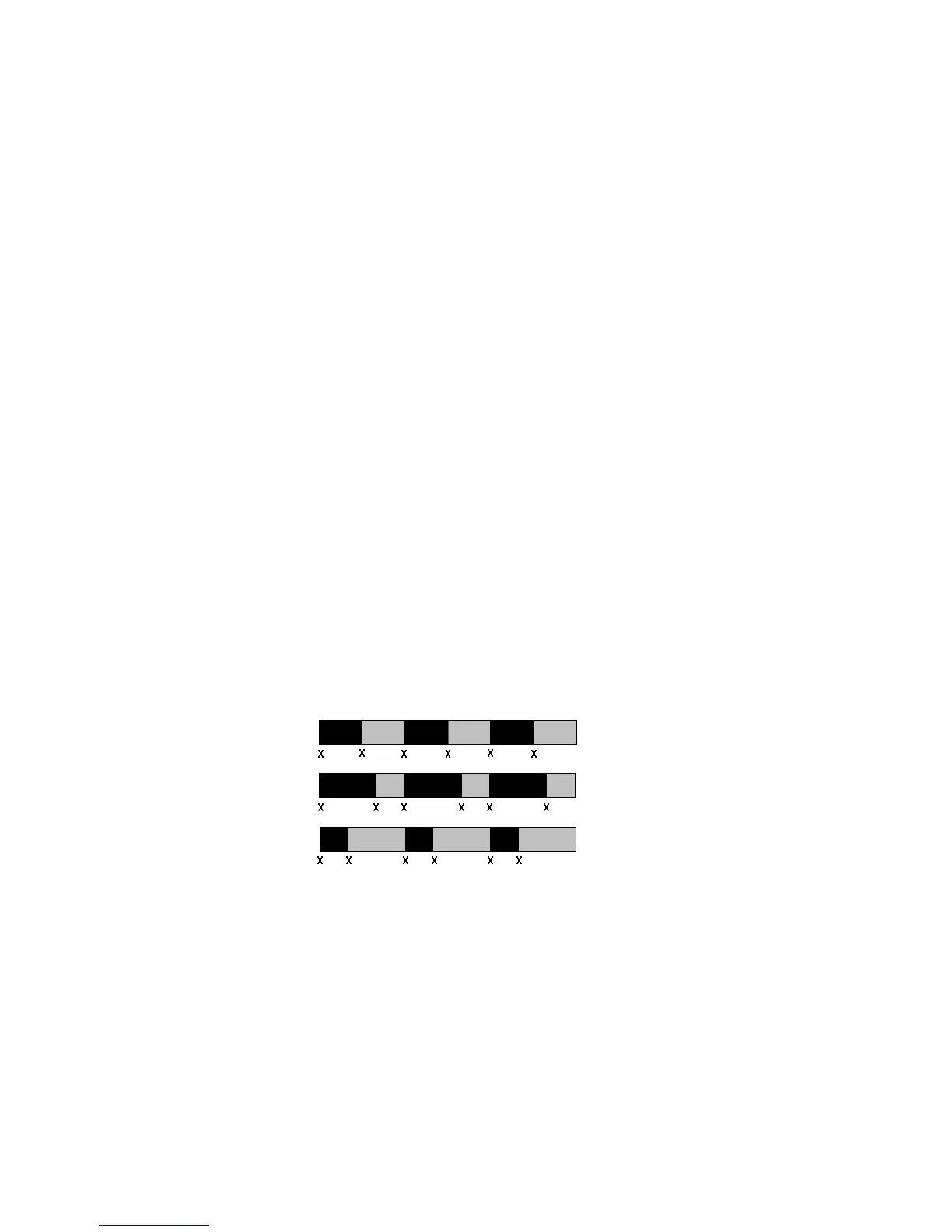
A swing value of 50 percent (the default) means that the grid points are
spaced evenly. A value of 66 percent means that the time between the
Þrst and second grid points is twice as long as the time between the
second and third points. The Þgure below illustrates the effect of the
swing setting on the timing grid:
Window
When you quantize some portion of a song, you might not want to adjust
notes that are very far from the grid. The window, or sensitivity,
setting lets you choose how close to the resolution grid a note must be
located for quantize to move it.
Swing = 50%
Swing = 66%
Swing = 33%



 To Next Page