7-3
Editing Audio
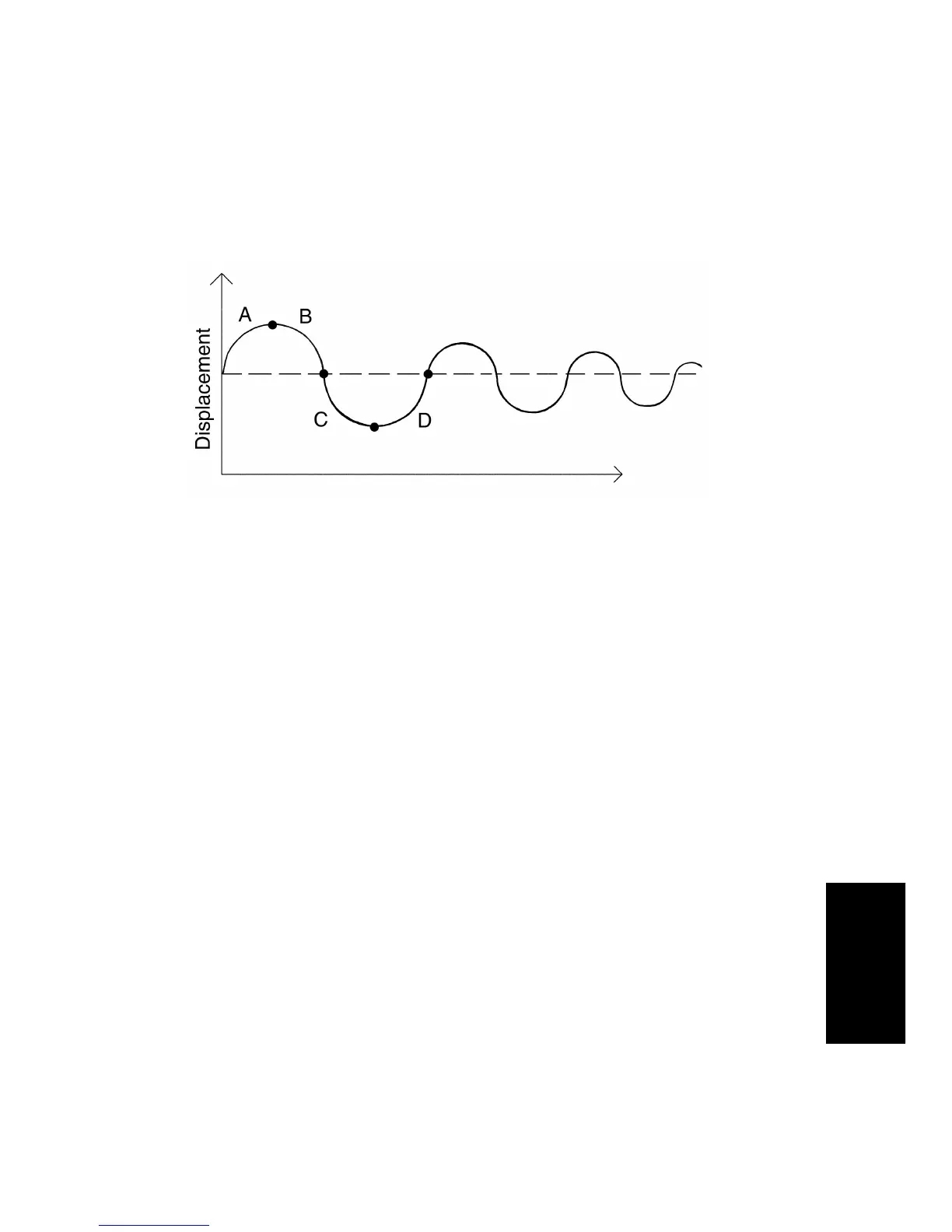
The displacement of the string changes as the string vibrates, as shown
here:
The segment marked ÒAÓ represents the string as it is pulled back by the
pick; ÒBÓ shows it moving back towards its resting point, ÒCÓ represents
the string moving through the resting point and onward to its outer
limit; then ÒDÓ has it moving back towards the point of rest. This pattern
repeats continuously until the friction of the molecules in the air
gradually slows the string to a stop. As the string vibrates, it causes the
molecules of air around it to vibrate as well. The vibrations are passed
along through the air as sound waves. When the vibrations enter your
ear, they make your eardrum vibrate, and you hear a sound. Likewise, if
the vibrating air hits a microphone, it causes the microphone to vibrate
and send out electrical signals.
In order for us humans to hear the sound, the frequency of the vibration
must be at least 20 Hz. The highest frequency sound we can hear is
theoretically 20 kHz, but, in reality, it's probably closer to 15 or 17 kHz.
Other animals, and microphones, have different hearing ranges.
If the simple back-and-forth motion of the string was the only
phenomenon involved in creating a sound, then all stringed instruments
would probably sound much the same. We know this is not true, of
course; the laws of physics are not quite so simple. In fact, the string
vibrates not only at its entire length, but at one-half its length, one-
third, one-fourth, one-Þfth, and so on. These additional vibrations
(overtones) occur at a rate faster than the rate of the original vibration
(the fundamental frequency), but are usually weaker in strength. Our
ear doesn't hear each frequency of vibration individually, however. If it if
did, we would hear a multinote chord every time a single string were



 To Next Page