46
Sequenced Capacity Control
While in the SEQUENCED mode, Automatic Capacity Control is used to adjust the capacity as documented
above. This is also true for Sequenced mode in Remote control. The master panel will wait for a remote indication
to start and according to the parameter setpoints in the sequencer setpoints screen then the master will turn on
and off the slave panels. If the master panel receives a remote indication to stop then the master panel will
sequentially communicate to the other panels to unload and all the panels will stay on-line
.
When a sequenced compressor is on-line, one of the following three commands will be sent from the master
sequencer controller.
• Trim When the trim command is sent from the master sequencer, the Viltech will start the RECIP
compressor. The Control Parameter and Control Setpoint will be also be sent from the master, and the
compressor will begin making capacity adjustments using Automatic Capacity Control. Once the
compressor is started, the status area will display RUN-TRIM indicating that the trim command was
received.
• Full Load When the Full Load command is sent from the Master Sequencer, the Viltech will force and
hold the compression at full capacity. When the Full Load command has been received the status area
will display FULL LOAD.
• Seq-Stop When the Seq Stop command is received from the master sequencer the Viltech will stop the
RECIP compressor automatically and leave it on-line for sequenced operation.
Low Alarm and Failure Setpoints
When Sequenced mode is enabled and the compressor is online or running, the local low alarm and failure
setpoints are replaced by the Sequencer low alarm and failure setpoints. This is true for both Suction
Pressure and Process Temperature operation. The local sensor is still used to generate the alarm or failure
condition.
Running in Trim Mode
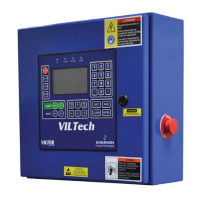
When the TRIM command is sent from the master sequencer the Viltech receives the System Control
Parameter, System Control Setpoint, and the sequencer load and unload deadband and bandwidth
parameters. These new control parameters are used instead of those defined on the Viltech itself. The
compressor’s local Normal Stage delay and Fast Stage delay are used for capacity changes.
The main status page will identify the control setpoint group as SY indicating that it is the System Control
Setpoint. Automatic Capacity Control is used to adjust the capacity while in Sequenced mode. The
System Control Parameter, System Control set-points, and Low Alarm and Failure setpoints are sent to the
compressor periodically by the master sequencer to ensure that the compressor is always using current
data. All automatic starting and stopping of the RECIP compressor is controlled by the master sequencer.
The local RECIP’s Cut-In and Cut-Out controls are also disabled. When the RECIP compressor is fully
loaded, limited, or forced to unload due to high process temp or suction pressure, the VILTech informs the
master sequencer that no further capacity increases are possible and additional compressors may be
needed.


 To Next Page