Need help?
Do you have a question about the EST EST3X and is the answer not in the manual?
Provides an overview of the manual's scope, intended audience, and fire alarm system limitations.
Provides an overview of the system control panel, hardware capabilities, components, accessories, and remote annunciators.
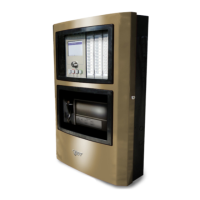
Details the physical components and models of the EST3X control panel, including an exploded view.
Lists the maximum hardware capabilities for a single EST3X control panel, including circuits and modules.
Highlights key programmable features configurable via the 3-SDU System Definition Utility.
Describes the standard components that can be installed within the control panel.
Explains the alphanumeric LCD screen, operator controls, and LED indicators used for panel interaction.
Describes the function of each system status LED (Alarm, Disable, SUP, GND Fault, CPU Fail, Trouble, Power).
Details the four event message queues (Alarm, Supervisory, Trouble, Monitor) and their dynamic maintenance.
Outlines the four user access levels, their default passwords, and the privileges associated with each level.
Describes how system commands are organized into menus selectable via the rotary controller.
Describes the different states the EST3X control panel operates in: normal, alarm, disable, supervisory, trouble, monitor, test, drill.
Provides initial power-up instructions for the EST3X control panel, including database download.
Explains how the rotary controller on the EST3X user interface is used for navigation and selection.
Provides instructions on how to silence all audible and visual alarm signals, with important warnings.
Explains the importance of acknowledging events and the steps involved in the process.
Provides instructions and warnings for resetting the fire alarm system to its normal state.
Provides instructions for clearing the panel history file, with a caution for authorized service technicians.
Describes how to retrieve maintenance and service-related information from the EST3X life safety network.
Provides instructions for isolating devices from the system and returning them to service.
Describes how to configure smoke detectors with two alarm sensitivity thresholds: primary and alternate.
Provides instructions on how to change user access level passwords for regulating access to controls and commands.
Details the three methods for downloading the 3-SDU database into the SFS1-CPU directly from a computer.
Explains how to set the system clock for the current time and date using the Change Time and Change Date commands.
Describes the digital audio subsystem including signal sources, amplifiers, and the 3X-PMI interface.
Details amplifier design for feeding audio zones, including output circuits and configurations.
Describes how audio channels are assigned priority levels during system configuration.
Lists the five types of page modes available: All Call, EVAC, Alert, All Call Minus, Selective Page.
Explains how R-Series remote annunciators communicate with the EST3X control panel and provide status indications.
Details the controls and indicators for LCD model remote annunciators like RLCD-C and RLCD.
Explains how to leverage EST3 network features like Mass Notification Service and UL/ULC Security Services.
Defines a security partition and how to arm them in Stay or Away states.
Describes how bypassing a security device suppresses its alarm events but allows other events to be processed.
Explains configuring the EST3X system to communicate with a building management system via a Communication Bridge.
Lists installation requirements for systems meeting UL 864 NAC signal synchronization.
Utilizes 3-SDU software to create an initial startup database for panel addresses and installation verification.
Provides basic instructions for installing a panel, referring to component-specific installation sheets.
Details the installation of components like the backbox, power supply, chassis, and option cards.
Provides warnings and descriptions for the PS10-4B Power Supply Board, essential for panel power.
Describes the SFS1-ELEC Chassis Assembly and its installed hardware and operator layer components.
Describes the 3-MODCOM module, its features for connecting to telephone networks, and configuration settings.
Explains how to connect the PT-1S serial printer to an EST3X control panel for printing system events.
Explains how to configure R-Series remote annunciators with a unique address and communication settings.
Describes runtime errors that can occur during database download due to mismatches or communication problems.
Details procedures for performing visual inspections of system components for damage or changes affecting performance.
Outlines procedures for performing routine maintenance and tests on the fire alarm system, including notifications.
Lists the essential tools needed for performing preventive maintenance and testing on the EST3X system.
Provides tips for maintaining Signature detectors, including removal procedures and CO sensor maintenance alerts.
Details the procedures for cleaning SIGA and SIGA2 detectors to ensure proper operation and accuracy.
Provides guidance on replacing components such as SIGA2 smoke chambers and CO sensor modules.
Presents a routine maintenance schedule for various system components, specifying frequency and recommended procedures.
Provides a template for logging system troubles and maintenance activities, including date, time, event, and initial.
Describes component-level field repairs, focusing on isolating faults to circuit cards and replacing defective cards.
Covers essential precautions for removing or replacing circuit board modules and handling static-sensitive components.
Addresses issues where the panel restarts and validates the database, suggesting steps to restore normal operation.
Focuses on troubleshooting specific hardware components, starting with the PS10-4B Power Supply.
Details troubleshooting steps for the SFS1-CPU Main Board, including LED indicators and potential replacement of the entire SFS1-ELEC assembly.
Explains troubleshooting for fiber network modules, including checking transceiver LEDs and testing jumpers.
Provides troubleshooting steps for 4X Series control-display modules, suggesting lamp tests to isolate hardware from programming issues.
Lists possible causes and solutions for issues related to zoned audio amplifier modules.
Explains LED indicator diagnostics and common problems associated with the 3-MODCOM module.
Details troubleshooting steps for the 3X-PMI interface, addressing issues with response, audio output, and microphone trouble states.
Defines pseudo points and lists system pseudo points with their addresses, labels, sources, and descriptions.
Explains advanced operations of the Signature controller module and lists loop conditions and operational responses.
Provides troubleshooting basics for Signature data loops, including isolating loop and device problems.
Explains the use of module LED indicators for determining communication and alarm status of Signature devices.
Covers substituting analog addressable driver controller modules and troubleshooting analog addressable detectors.
Explains module LED indicators and common causes for analog addressable module problems.
Discusses common analog addressable loop problems: excessive resistance, excessive capacitance, and ground faults.
Provides methods for locating addressing faults and duplicate device faults.
Explains how to use HyperTerminal for gathering information and troubleshooting system faults via an RS-232 connection.
Defines cumulative data network capacitance limits required for stable network communications.
Discusses data and audio network cable properties, including resistance and capacitance variations.
Explains how to calculate the maximum length of a data network based on cumulative capacitance and cable rating.
Explains how signaling line circuit resistance and capacitance determine the maximum length of a Signature data loop.
Details how to determine the maximum branch length from the Signature controller module to the last device.
Provides methods (worksheet and equation) to determine the maximum cable length for notification appliance circuits.
Details calculating maximum allowable wire length for notification appliance circuits based on amplifier output and circuit load.
Lists the maximum wire distances allowed for analog addressable circuits, noting resistance and capacitance limits.
Explains how to calculate the minimum ampere-hour capacity of a battery required for panel operation during AC power absence.
Provides a worksheet for calculating the required size of standby batteries based on operating time requirements.
Provides a worksheet for verifying light attenuation factors against the fiber optic budget for cable segments.
Explains the PPCCDDDD address format used for EST3X addressing, defining PP, CC, and DDDD.
Details physical and logical addresses for cards installed in the EST3X panel, referencing Table 82 and Figure 60.
Lists device addresses for points located on the EST3X hardware layer, categorized by card.
Provides device addresses for points on the EST3X operator layer, categorized by module type.
Lists device addresses for LEDs and switches on various R-Series remote annunciators and expanders.
Lists the addresses for various EST3X logic groups, including Command lists, Partitions, and Zone groups.
Summarizes panel programming options, detailing features permitted in UL 864, possible settings, and UL 864 permitted settings.
 General
| Brand | EST |
|---|---|
| Model | EST3X |
| Category | Security System |
| Language | English |

 To Next Page