Chapter 7 Fastening Instructions
PAGE 7-10
7-2-2 Angle Control Method (Torque Monitoring)
In Angle Control method, fastening is performed based upon attaining a desired torque value and then
rotating the fastener a specified number of degrees, while monitoring the torque of the fastener and
time. Additional check items (limits, rate, time, etc.) can be set to enhance the systems ability to
determine if the fastener was properly secured. Fastening can be performed from 1 to 3 incremental
steps that will successively secure the fastener to a specified torque or angle value before attaining the
final number of degrees of rotation.
Angle Control method is primarily used when greater control of clamp load is required. (Angle Control
specs. are developed through testing of the joint and fastener characteristics and therefore should not
be attempted unless testing is performed)
NOTE: When performing multiple step Angle control fastening, the rotation Angle should be
performed as one continuous operation. There should be no intermediate stop/synchronization
points once Snug Torque has been sensed and rotation angle is being controlled. Under
special conditions multiple steps can be performed using intermediate Torque or Angle
stop/synchronization points.
<Angle Control Method・
・・
・One-step Fastening>
P
One-step fastening will be used primarily for joints which have no requirement to synchronize with
another spindle during the final stage of the rundown.
1. Once RAMP DOWN START TORQUE is reached or FREERUN REVOLUTIONS expires, the
system will switch from FREERUN SPEED to 1ST SPEED and continue to fasten to 1ST
TORQUE/ANGLE.
2. The system will fasten to the 1ST TORQUE/ANGLE value during the specified 1ST TIME.
1ST TORQUE/ANGLE must be reached within the 1ST TIME limits or a reject will occur.
3. Upon reaching 1ST TORQUE/ANGLE, 1ST TIME ends and 2ND TIME begins. 1ST
TORQUE/ANGLE is the shift point to 2ND SPEED.
4. Upon reaching 2ND TORQUE/ANGLE the system with shift to 3RD SPEED. The system will
then fasten to STANDARD ANGLE. STANDARD ANGLE must be reached within the 2ND
TIME limits or a reject will occur.
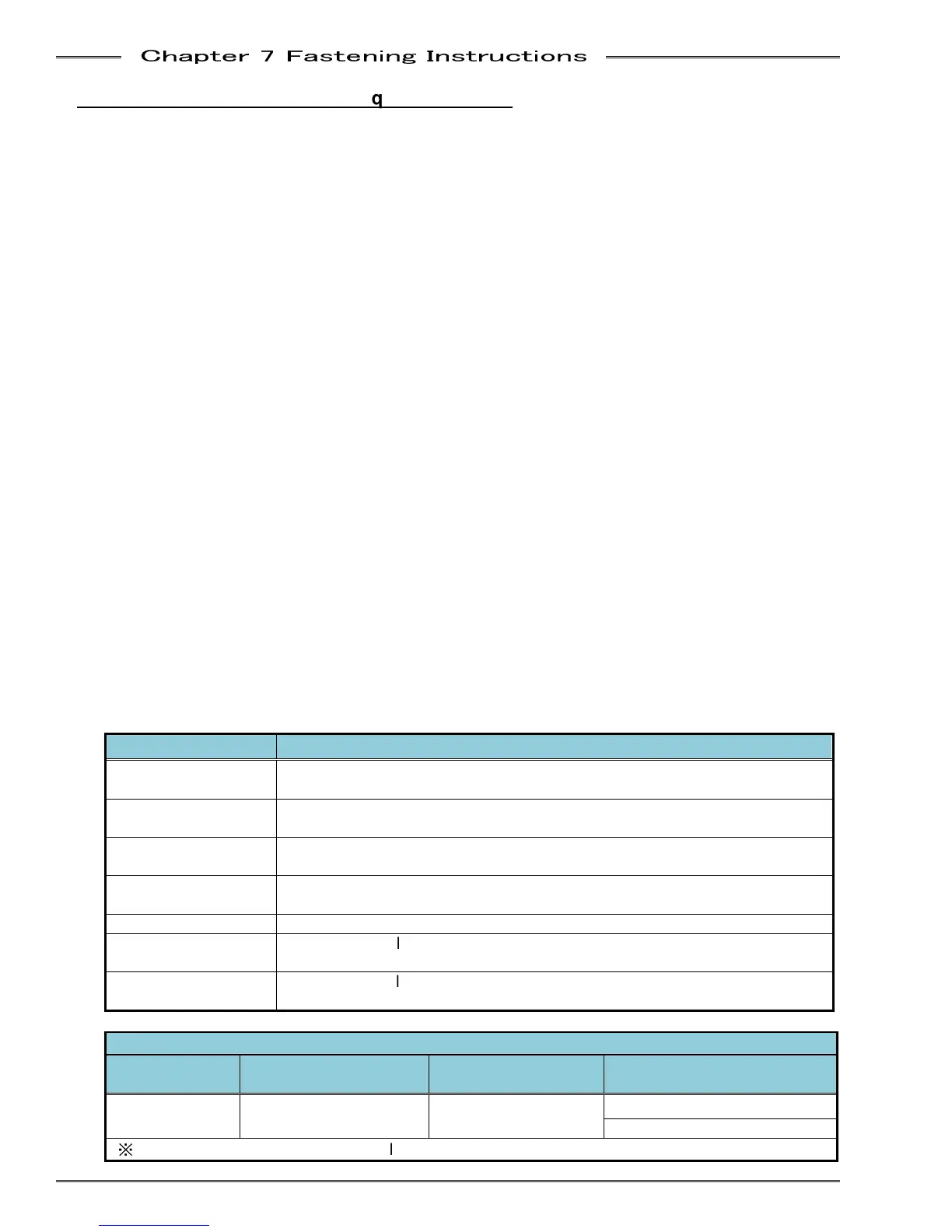
Function
Recommendation/Comment
Ramp Down
Start Torque
30% of SNUG Torque.
Set the value right before fastener seating.
1
Torque
1
ST
Angle
80% of SNUG Torque.
1
st
Time end point and 2
nd
Speed start point.
SNUG Torque
Used for angle control start point.
Set the value when the torque increase is stable after fastener seating.
2
Torque
2
ND
Angle
Set this torque 60% of the Judgment Torque
Used for 3
rd
speed start point.
Standard Angle Engineered product fastening specification
1
1
ST
Time Low Limit
The high and low limits from starting the fastening to detecting 1
T
or 1
st
Angle.
2
2
ND
Time Low Limit
The high and low limits from detecting 1
Torque or 1
the Standard Angle.
Function
Starting Point Stop Point
fastening
1
st
Step Start of operation Standard Angle
1
st
Time Low Limit / High Limit
2
Time Low Limit / High Limit
※
The synchronization between spindles at 1
st
Torque or 1
st
Angle is not available.


 To Next Page