Chapter 7 Fastening Instructions
PAGE 7-35
7-3-3 Differential Angle Check
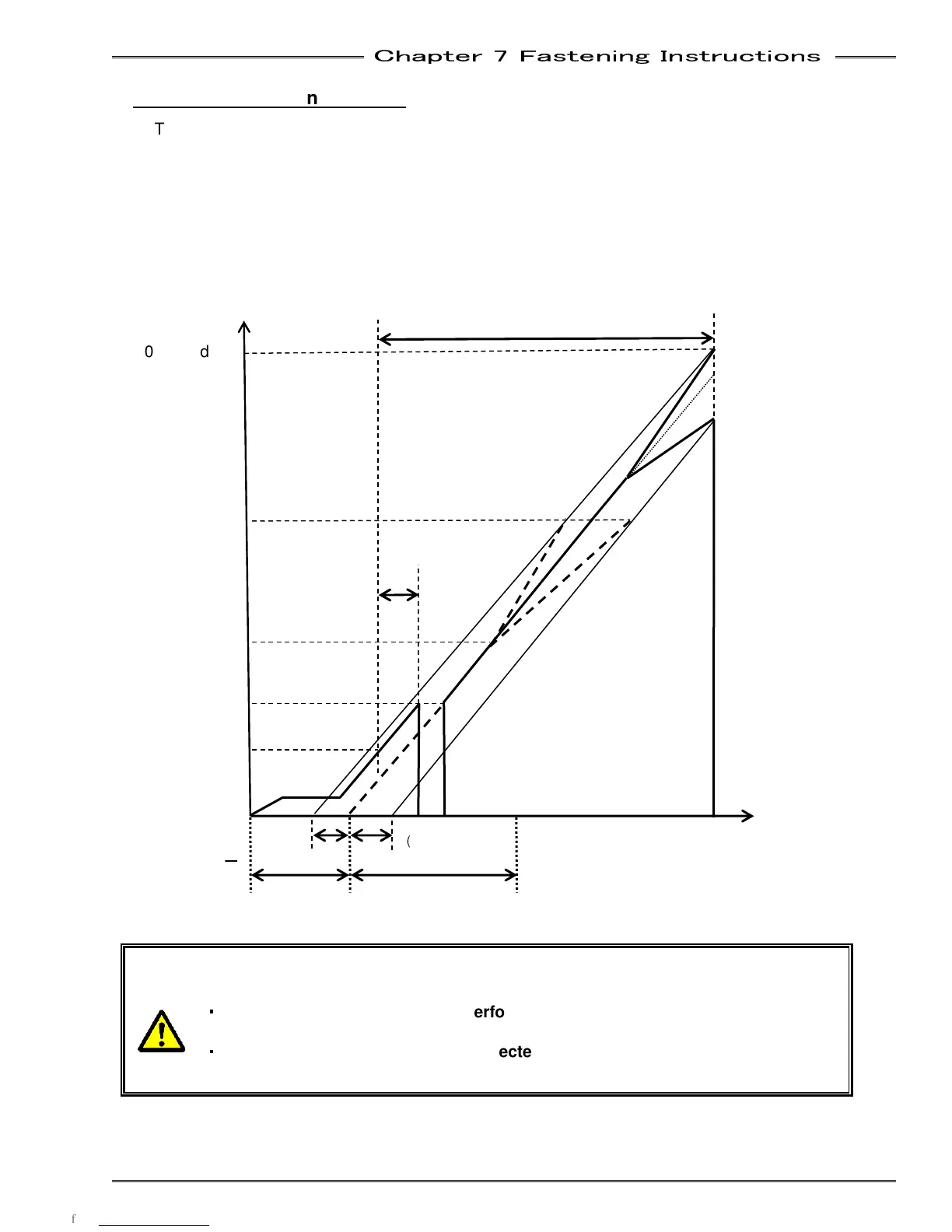
The Differential Angle Check is calculated by taking the difference between the seating point (angle) of
the final torque and the seating point calculated by 2
nd
Rate. When the fastening ends, the fastening is
judged by this Differential Angle. The seating point (angle) calculated by 2
nd
Rate is calculated with 2
nd
Rate Start Torque and 2
nd
Rate End Torque.
If Differential Angle Check is used, it judges whether the calculated Differential Angle is within a high
(Differential + Angle) or low (Differential – Angle) limit by using the seating point calculated by 2
nd
Rate
as a base point.
This function is useful to detect bolt stretch in applications where the fastener torque rates may vary
making it difficult to set normal Final Angle limits.
・
・・
・Differential Angle Check is not performed if the 2
nd
Rate judgment is disabled
even when Differential Angle Check is enabled.
・
・・
・
Differential Angle Check is not performed when the 2
nd
Rate Start Torque is not
detected during fastening.
・
・・
・
If the 2
nd
Rate End Torque is not detected during the fastening, the torque value
which is detected when the fastening ends is judged as 2
nd
Rate End Torque.
Torque
202 Standard Angle
115 2
Rate
End Torque
114 2
Rate
Start Torque
303 2
Rate High Limit
302 2
Rate
Low
Limit
105 1
Torque
107 SNUG Torque
DIFF Angle
(Fastening
Results)
Angle
206 DIFF+
Angle
207 DIFF
-
Angle
Seating point calculated by 2nd Rate
103 Standard
Torque
203 1
st
Angle


 To Next Page