CHAPTER 9
Port Cable and Pinout Specifications
•
MX104 Clocking and Timing Ports Overview on page 83
•
MX104 Routing Engine Ethernet Port Specifications on page 84
•
MX104 Routing Engine Auxiliary and Console Ports Specifications on page 85
•
MX104 Routing Engine USB Port Specifications on page 86
•
MX104 Alarm Contact Port Specifications on page 87
•
MX104 BITS Port Specifications on page 89
•
MX104 1-PPS and 10-MHz GPS Port Specifications on page 90
•
MX104 Time of Day Port Specifications on page 90
MX104 Clocking and Timing Ports Overview
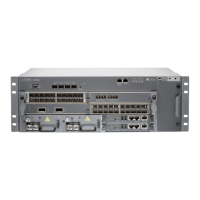
Four Subminiature B (SMB) connectors (for 10-MHz and 1-PPS), one RJ-48 port (for
BITS), and one RS-232 port (for TOD) on the front panel of the router connect to external
clock signal sources. The clocking ports provide the synchronized output clocks from any
one of the reference clock inputs based on the clock’s priority.
The reference clock inputs can be Ethernet-recovered clocks, T1 or E1 line clocks, IEEE
1588v2-recovered clocks, BITS timing, 10-MHz timing, and 1-PPS timing. The T1 or E1 line
clock also supports loop timing. These clocking ports distribute a synchronized clock
signal throughout the chassis by locking onto the selected clock source. In the absence
of these configured ports, the local oscillator present in the system provides the chassis
synchronization.
Clock sources within the MX104 router include:
•
External clock timing port
•
10-MHz timing connectors (one input and one output)
•
1-pulse-per-second (PPS) connectors (one input and one output)
•
Time-of-day (TOD) RS-232 port
•
Synchronous Ethernet support on SFP ports as timing input or output
•
Packet (IEEE 1588-2008) v2 timing includes:
•
Timing input when configured as Ordinary Clock (OC) or Boundary Clock (BC)
83Copyright © 2017, Juniper Networks, Inc.


 To Next Page