CAUTION: Do not bend fiber-optic cables beyond their minimum bend
radius.An arc smallerthan a few inches in diameter can damagethe cables
and cause problems that are difficult to diagnose.
Do not let fiber-optic cables hang free from the connector. Do not allow
fastened loops of cables to dangle, which stresses the cables at the
fastening point.
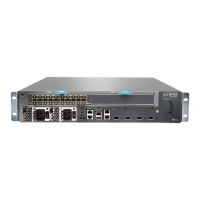
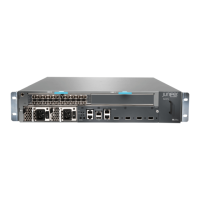
Replacing an MX104 Alarm Cable
•
Disconnecting the Router from an External Alarm-Reporting Device on page 141
•
Connecting the MX104 Router to an External Alarm-Reporting Device on page 141
Disconnecting the Router from an External Alarm-Reporting Device
Ensure that you have the following parts and tools available:
•
Electrostatic discharge (ESD) grounding strap
•
2.5-mm flat-blade (–) screwdriver
To connect an external device to an alarm relay contact:
1. Remove the other end of the wires to the external device.
2. Attach an ESD grounding strap to your bare wrist and connect the strap to one of the
ESD points on the chassis.
3. Loosen the small screws on the face of the terminal block using a screwdriver and
remove the block from the relay contact.
4. Loosen the small screws on the side of the terminal block using a screwdriver. Remove
existing wires from the slots in the front of the block.
Connecting the MX104 Router to an External Alarm-Reporting Device
Ensure that you have the following parts and tools available:
•
Electrostatic discharge (ESD) grounding strap
•
2.5-mm flat-blade (–) screwdriver
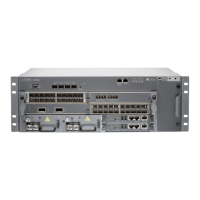
To connect the router to external alarm-reporting devices, attach wires to the ALARM
relay contacts on the front panel of the router. A system condition that triggers the red
or yellow alarm on the router also activates the corresponding alarm relay contact.
The terminal blocks that plug into the alarm relay contacts are supplied with the router.
They accept wire of any gauge between 20 AWG (0.52 mm
2
) and 14 AWG (2.08 mm
2
),
141Copyright © 2017, Juniper Networks, Inc.
Chapter 19: Replacing Chassis Components


 To Next Page