4-5. Using the driving support systems
O On an extremely bumpy road, on an
incline, on gravel, or on grass.
O When vehicle horns, vehicle detectors,
motorcycle engines, air brakes of large
vehicles, the clearance sonar of other
vehicles or other devices which produce
ultrasonic waves are near the vehicle.
O A sensor is coated with a sheet of spray
or heavy rain.
O If objects draw too close to the sensor.
O When a pedestrian is wearing clothing
that does not reflect ultrasonic waves (ex.
skirts with gathers or frills).
O When objects that are not perpendicular
to the ground, not perpendicular to the
vehicle traveling direction, uneven, or
waving are in the detection range.
O Strong wind is blowing.
O When driving in inclement weather such
as fog, snow or a sandstorm.
O When an object that cannot be detected
is between the vehicle and a detected
object.
O If an object such as a vehicle, motorcycle,
bicycle or pedestrian cuts in front of the
vehicle or runs out from the side of the
vehicle.
O If the orientation of a sensor has been
changed due to a collision or other
impact
O When equipment that may obstruct a
sensor is installed, such as a towing eye-
let, bumper protector (an additional trim
strip, etc.), bicycle carrier, or snow plow.
O If the front of the vehicle is raised or low-
ered due to the carried load.
O If the vehicle cannot be driven in a stable
manner, such as when the vehicle has
been in an accident or is malfunctioning.
O When tire chains, a compact spare tire or
an emergency tire puncture repair kit are
used.
Q Situations in which the system may
operate even if there is no possibility of a
collision
In some situations, such as the following, the
system may operate even though there is
no possibility of a collision.
O When driving on a narrow road
O When driving toward a banner, flag, low-
hanging branch or boom barrier (such as
those used at railroad crossings, toll
gates and parking lots)
O When there is a rut or hole in the surface
of the road
O When driving on a metal cover (grating),
such as those used for drainage ditches
O When driving up or down a steep slope
O If a sensor is hit by a large amount of
water, such as when driving on a flooded
road
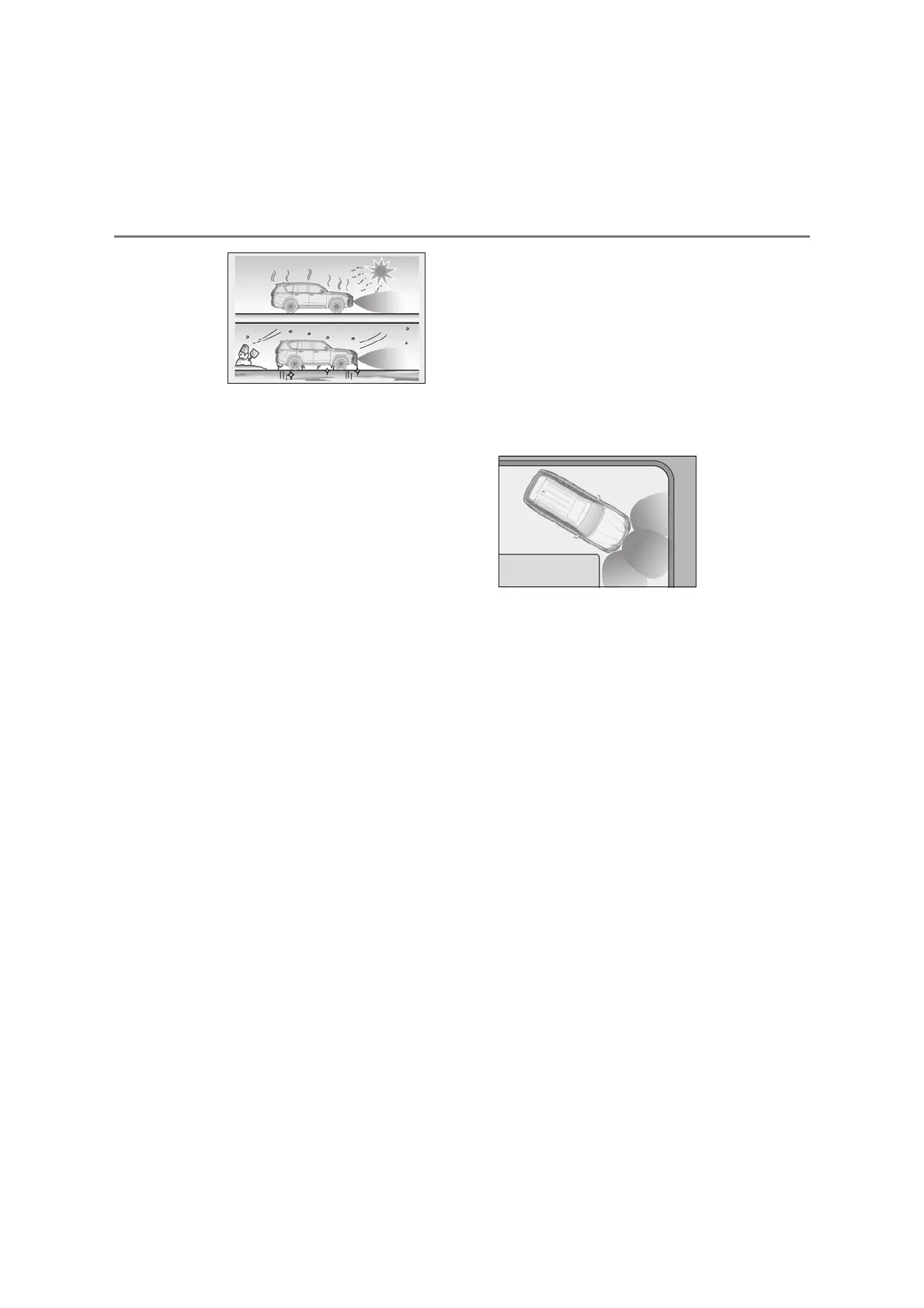
O There is dirt, snow, water drops or ice on
a sensor. (Cleaning the sensors will
resolve this problem.)
O A sensor is coated with a sheet of spray
or heavy rain
O When driving in inclement weather such
as fog, snow or a sandstorm
O When strong winds are blowing



 To Next Page