Alpha/Delta (Kinetic Operator) Installation and Maintenance Manual Revision 1 - MAY 2023
101
ADJUSTING THE IES SENSITIVITY
Adjusng the IES Sensivity
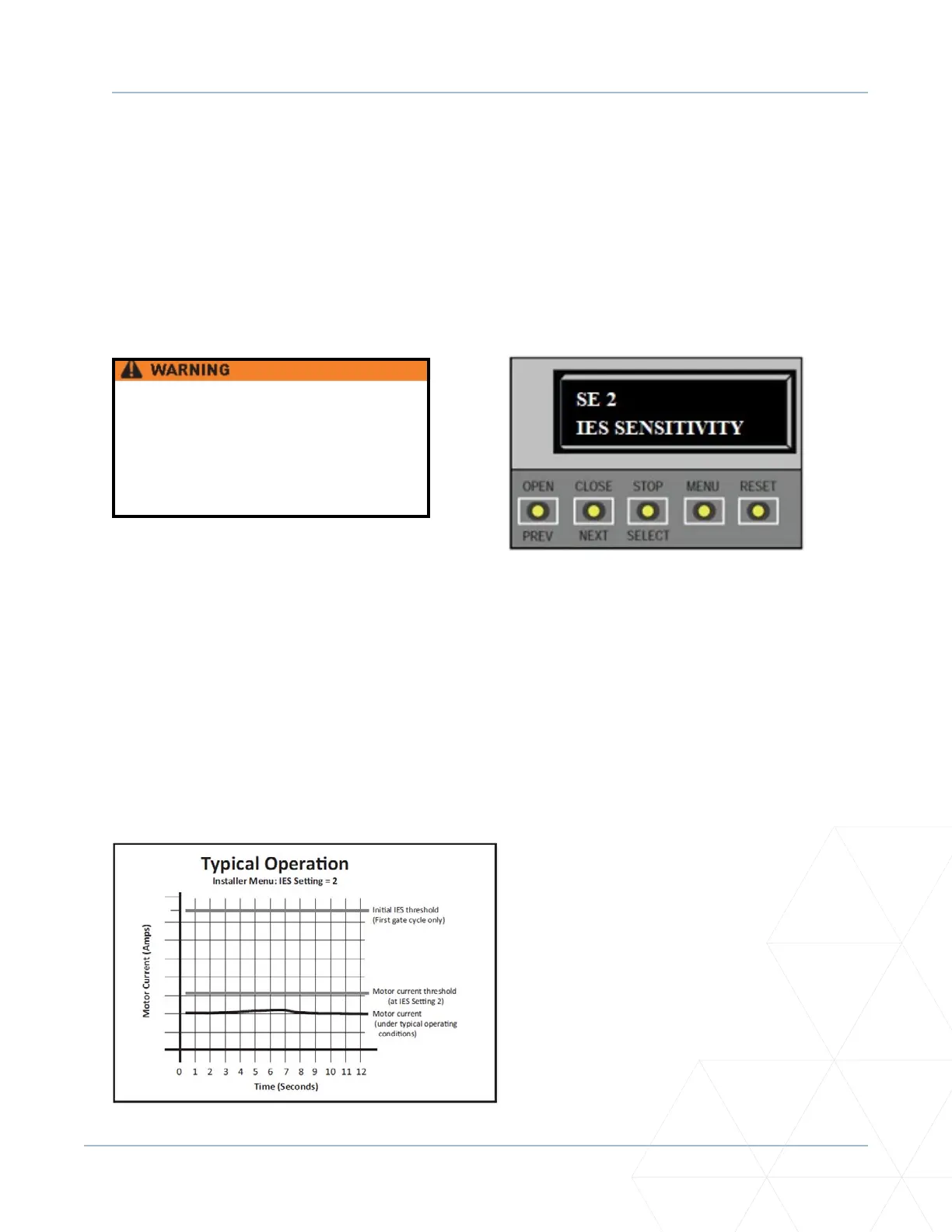
The adapve IES (Inherent Entrapment Sensor) soware monitors the average running motor current
while the gate is in moon and reverses the gate when the current exceeds an automacally self-adapng
average.
The IES display, accessed through the Installer Menu, allows you to input a number between 0 and 9. The
sengs (0 through 6) allow an increasingly higher threshold (amount of headroom) above the average
current draw before tripping. For IES sengs 7 through 9, the current limit is a xed relavely high value
before the IES will be tripped. The factory seng is 2, which is adequate for most sites.
Avoid seng the IES sensivity to
a xed level (7 - 9 seng). The high
motor current required for the IES to
trip could cause severe injury or death
to people caught in the moving gate.
For IES sengs (0 through 6) the motor current is connually being measured and the IES threshold
automacally set to trip at the average current plus the addional “headroom” provided by the IES seng
selected.
To prevent false IES trips, the soware boosts the IES current threshold for one gate cycle aer an IES
event, then returns to the normal sensivity threshold.
Over me, degrading gate hardware and other site issues, such as road seling or debris on the gate rail,
can occur. As the gate hardware ages and becomes ser, the Kinec motor current increases and this may
create the need to use a higher IES seng level. The higher sengs should only be used on a TEMPORARY
basis unl the gate, gate track, or wheels are repaired so the gate rolls smoothly with minimum resistance.
NOTE: When wind load increases,
IES soware adapts and changes the
threshold allowance. The IES threshold
automacally increases by 50% when the
temperature drops below 32°F (0°C)
.



 To Next Page