6
ENGLISH
Note a: Field strengths from fixed transmitters, such as base stations for radio (cellular/
cordless) telephones and land mobile radios, amateur radio, AM and FM radio broadcast
and TV broadcast cannot be predicted theoretically with accuracy. To assess the
electromagnetic environment due to fixed RF transmitter, an electromagnetic site survey
should be considered. If abnormal performance of the TRIOS system is observed, additional
measures may be necessary, such as re-orienting or relocating the TRIOS system.
Note b: Over the frequency range 150 kHz to 80 MHz, field strengths should be less than 3 V/m.
Note c: The ISM (industrial, scientific and medical) bands between 0.15 MHz and 80 MHz
are 6.765 MHz to 6.795 MHz; 13.553 MHz to 13.567 MHz; 26.957 MHz to 27.283 MHz; and
40.66 MHz to 40.70 MHz. The amateur radio bands between 0.15 MHz and 80 MHz are
1.8 MHz to 2.0 MHz, 3.5 MHz to 4.0 MHz, 5.3 MHz to 5.4 MHz, 7 MHz to 7.3 MHz, 10.1 MHz
to 10.15 MHz, 14 MHz to 14.2 MHz, 18.07 MHz to 18.17 MHz, 21.0 MHz to 21.4 MHz, 24.89
MHz to 24.99 MHz, 28.0 MHz to 29.7 MHz and 50.0 MHz to 54.0 MHz.
Enclosure port immunity to RF wireless communications equipment
Band (MHz) Service Immunity test level (V/m)
380-390 TETRA 400 27
430-470
GMRS460,
FRS 460
28
704-787 LTE Band 13, 17 9
800-960
GSM 800/900,
TETRA 800,
iDEN 820,
CDMA 850,
LTE Band 5
28
1700-1990
GSM 1800;
CDMA 1900;
GSM 1900;
LTE Band 1,3,4, 25;
UMTS
28
2400-2570
Bluetooth,
WLAN,
802.11 b/g/n,
RFID 2450
LTE Band 7
28
5100-5800 WLAN 802.11 a/n 9
4.16 Distances Between System and Other Equipment
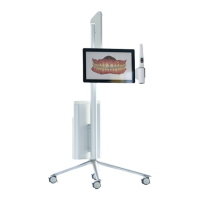
The TRIOSMOVE+ is intended for use in an electromagnetic environment in which radiated RF
disturbances are controlled. The customer or the user of the TRIOSMOVE+ can help prevent
electromagnetic interference by maintaining a minimum distance between portable or mobile
RF communications equipment (transmitters) and the TRIOSMOVE+ as recommended below,
according to the maximum output power of the communication equipment.
Rated maximum output
power of transmitter, W
Separation distance according to frequency
of transmitter, m
150 kHz
to80 MHz
d = 1,2
P
80 MHz
to800MHz
d = 1,2
P
800 MHz
to2,5 GHz
d = 2,3
P
0,01 0,12 0,12 0,23
0,1 0,38 0,38 0,73
1 1,2 1,2 2,3
10 3,8 3,8 7,3
100 12 12 23
For transmitters rated at a maximum output power not listed above, therecommended
separation distance d in metres (m) can be estimated using the equation applicable
to the frequency of the trans-mitter, where P isthemaximum output power rating
of the transmitter in watts (W) according tothetransmitter manufacturer.
Note 1: At 80 MHz and 800 MHz, the separation distance for the higher frequency
range applies.
Note 2: These guidelines may not apply in all situations. Electromagnetic propagation
is affected by absorption and reflection from structures, objects and people.
Recommended use distances
Connection Type Recommended use distances
MOVE+ - Scanner Wireless
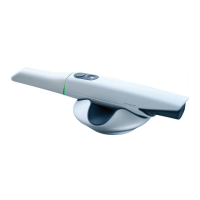
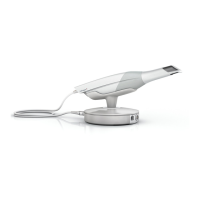
Distance between TRIOSMOVE+ and Scanner/
access point should be between 0.5 and 5m for
best performance.
Network
Twisted pair
(shielded)
Distance between TRIOSMOVE+ and network
should be less than 5m for best performance.
5. System Safety
5.1 Prerequisites
CAUTION
Read all instructions carefully, including all warnings and caution notices.
You must comply with the warnings in this manual to prevent injury to
persons and damage to equipment. Proper functionality and safety can
only be guaranteed if the safety precautions in this safety guide and on the
TRIOSMOVE+ are observed.
Preventive inspection before use of the system
WARNING
Please examine the TRIOSMOVE+ for any mechanical
damage on:
• All enclosures.
• All cables.
Safety can only be guaranteed if NO DAMAGE to the
TRIOSMOVE+ is observed.
Modifications of the system
Warning
Do not modify the TRIOSMOVE+ without authorization from the manufacturer.
Approved software only
CAUTION
Install only approved software – to prevent interference with TRIOSMOVE+
performance.
Training
WARNING
Before you attempt to use the TRIOS system with patients:
• You must have read and understood all sections of this guide describing
correct operation.
• You must be thoroughly familiar with the safe operation of the
TRIOSMOVE+ as described in this documentation.
• If the instructions for operating the TRIOSMOVE+ as described in this
guide are NOT observed and followed, the intended function and its
safety for the user and patient may be impaired.
In case of equipment failure
CAUTION
If at any time the TRIOSMOVE+ malfunctions, or if you suspect in any way
that the TRIOSMOVE+ is not working correctly:
• Remove the TRIOS scanner contact to patient immediately.
• Unplug the mains power cable and make sure it cannot be used before
it is checked.
• Contact your 3Shape support.
• Do not attempt to open any covers on the TRIOSMOVE+.
Wireless Connection
The wireless TRIOSMOVE+ is intended to be used indoors, in a domestic or commercial
electromagnetic environment. The wireless connection is intended to relay image stream
data and control data between the TRIOS scanner and the TRIOSMOVE+. The communication
between TRIOS Scanner and TRIOSMOVE+ is handled by 3Shape communication services.
CAUTION
Other portable and mobile RF communication equipment could interfere
with the TRIOSMOVE+, even if the other equipment complies with CISPR
emission requirements.
CAUTION
The TRIOSMOVE+ could interfere with other portable and mobile RF
communication equipment.
IMPORTANT NOTICE
It is recommended to keep a line of sight between the wireless TRIOS
scanner and the TRIOSMOVE+.


 To Next Page
 Loading...