153
THIS IS AN UNCONTROLLED DOCUMENT.
THIS ELECTRONIC DOCUMENT MAY HAVE BEEN SUPERCEDED.
THE MOST CURRENT DOCUMENT INFORMATION IS AVAILABLE
FROM YOUR BELL HELICOPTER TEXTRON REPRESENTATIVE.
PRODUCT DATA JANUARY 2003
CONSTRUCTION FEATURES
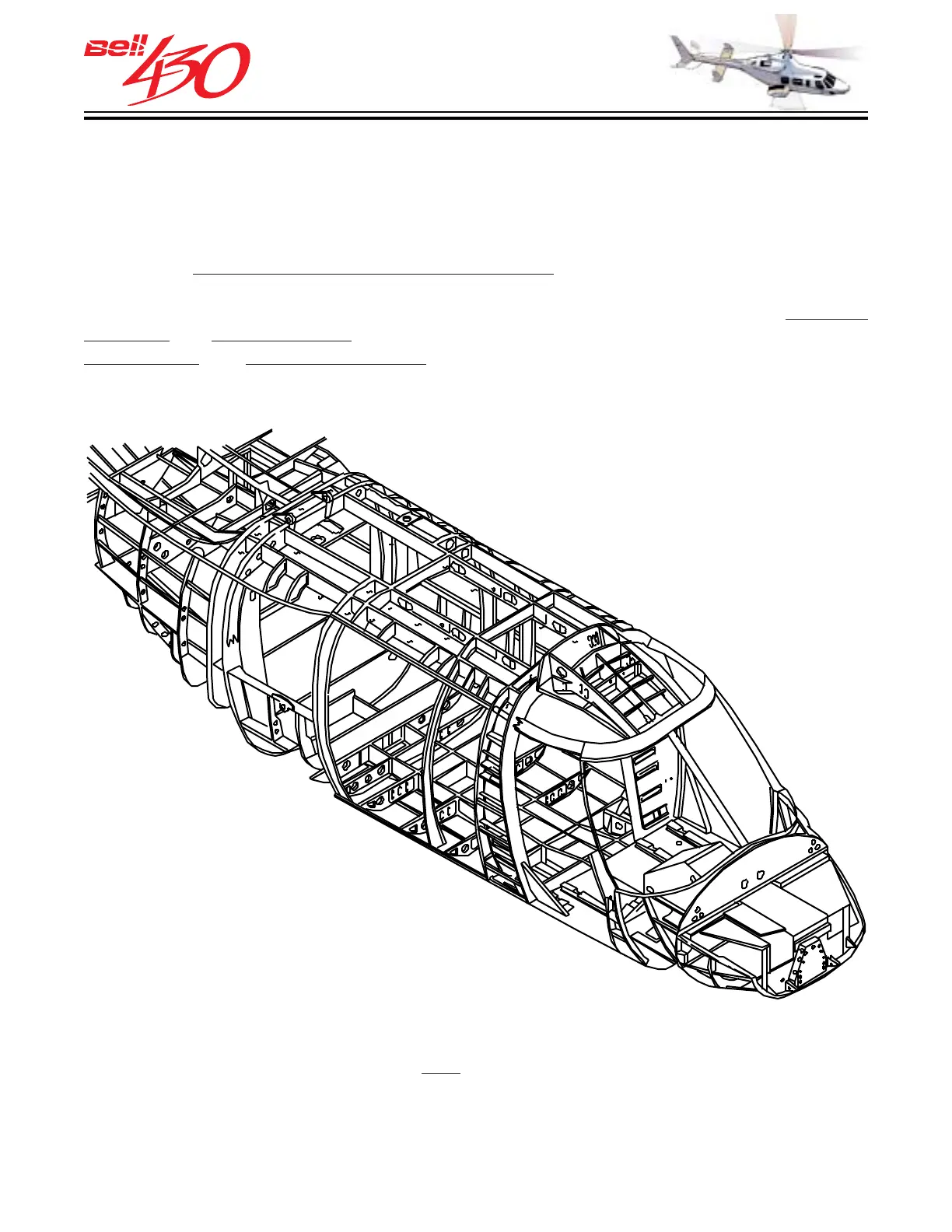
The airframe is a conventional semi-monocoque structure of bulkheads, support beams,
stringers, and cast and machined fittings, which are held together by intercostals and
covered with an external skin. The primary construction material is corrosion resistant
aluminum alloy. It features extensive use of high temperature bonded honeycomb
panels with
long life, high strength, and light weight. Non-structural fiberglass molded
panels are also used. These reduce maintenance requirements and enhance the overall
appearance of the helicopter by presenting smooth contours. Protection against
corrosive
elements and galvanic action is provided by a coating of epoxy polyamide primer. All
panel edges and fiberglass surfaces are sealed and spot welding is NOT used. The
exterior surface of the helicopter is further protected by very durable polyurethane
paint.
FUSELAGE ASSEMBLY
The fuselage assembly consists of three major components; the forward fuselage,
the aft fuselage, and the tail boom. The three sections of the fuselage assembly are
fixture (JIG) mated into one integral
unit. A tunnel extends along the centerline of the
fuselage to house and protect the electrical wiring that goes aft, and the flight control
mechanical linkage and hydraulic lines which operates the tail rotor. This permits ready
access without disturbing any of the interior.



 To Next Page