thru,
20000 Hz
RESPONSE:
thru, 6dB,
12dB/Q=0.5, 12dB/Q=0.6,
12dB/Q=0.7,
12dB/Q=0.8, 12dB/Q=1.0,
12dB/Q=1.2,
12dB/Q=1.5, 12dB/Q=2.0,
Bessel 12dB, Butterworth
12dB, Linkwitz/Riley 12dB,
Bessel 18dB, Butterworth
18dB, Bessel 24dB,
Butterworth 24dB, Linkwitz/
Riley 24dB
FREQ:
20 Hz...20 kHz
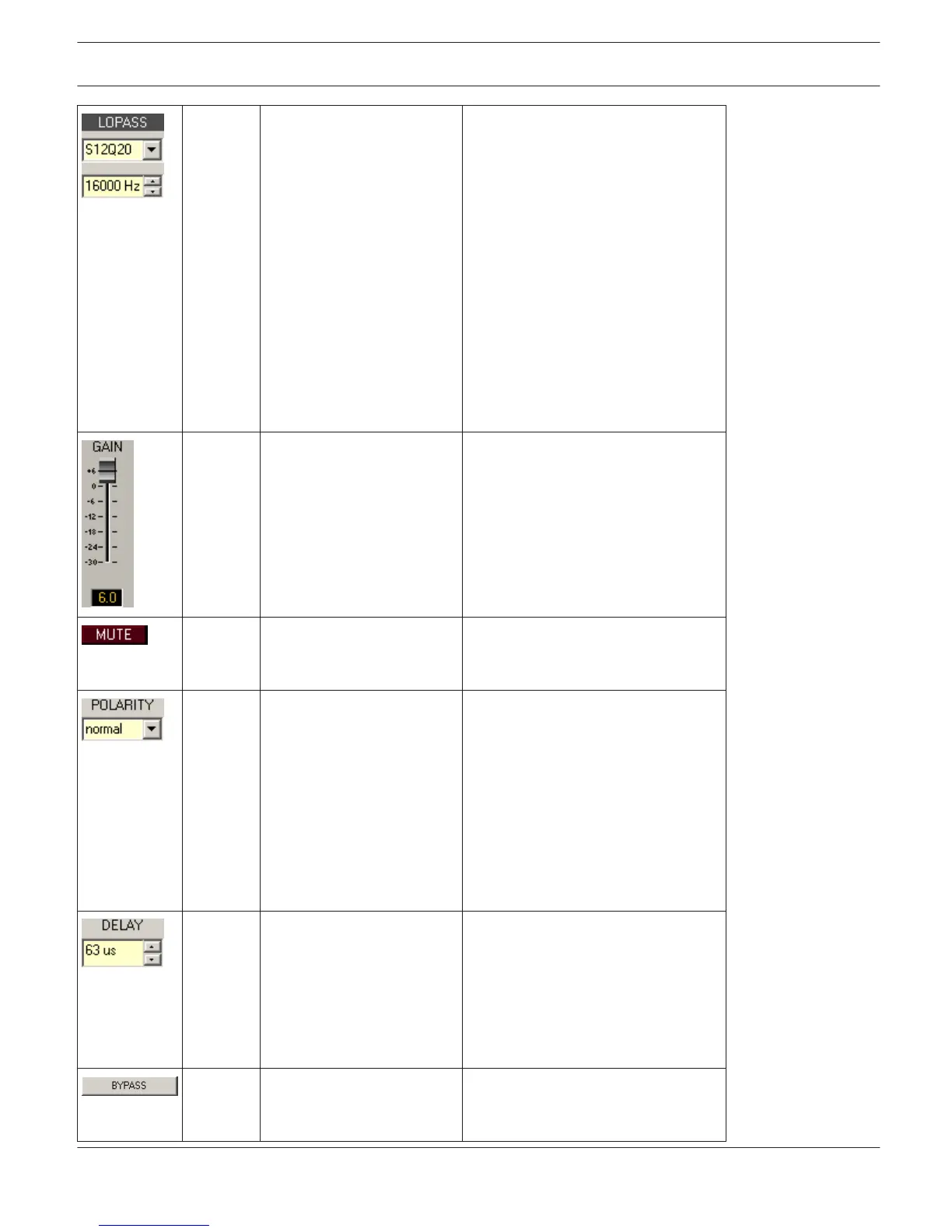
This parameter block represents the
LOPASS filter. Setting different filter
types (Bessel, Butterworth, Linkwitz/
Riley) with slopes between 6 dB/Oct
and 24 dB/Oct and cut-off
frequencies between 20 Hz and 20
kHz is possible.
0 dB -30...+6 dB GAIN TRIM is for amplifying the level
of the corresponding channel by up
to 6 dB or attenuating it by as much
as 30 dB, which allows matching
levels of the frequency bands
amongst each other.
The Mute button allows muting the
signal of the loudspeaker cont- roller
block's selected way.
normal normal, inverted POLARITY allows inverting a channel,
e.g. shifting its phase by 180°. Some
frequency crossover settings need
phase inversion, because otherwise,
it dropouts appear at the crossover
frequency. The influence of the
polarity parameter becomes clearly
evident in summed indication of the
two amplifier channels (switch to
Sum).
0.0 ms 0.0...500.0 ms DELAY allows delaying the signal of
the corresponding way by a settable
amount of time. Typically, this delay
is used as time alignment delay to
overcome the difference in distance
between the loudspeaker systems
within a cabinet.
BYPASS activates (not engaged) or
deactivates (enganged) the
corresponding delay.
IRIS-Net DIGITAL MATRIX | en 428
Bosch Security Systems B.V. User Manual 2017.05 | 3.20 | F.01U.119.956



 To Next Page