181
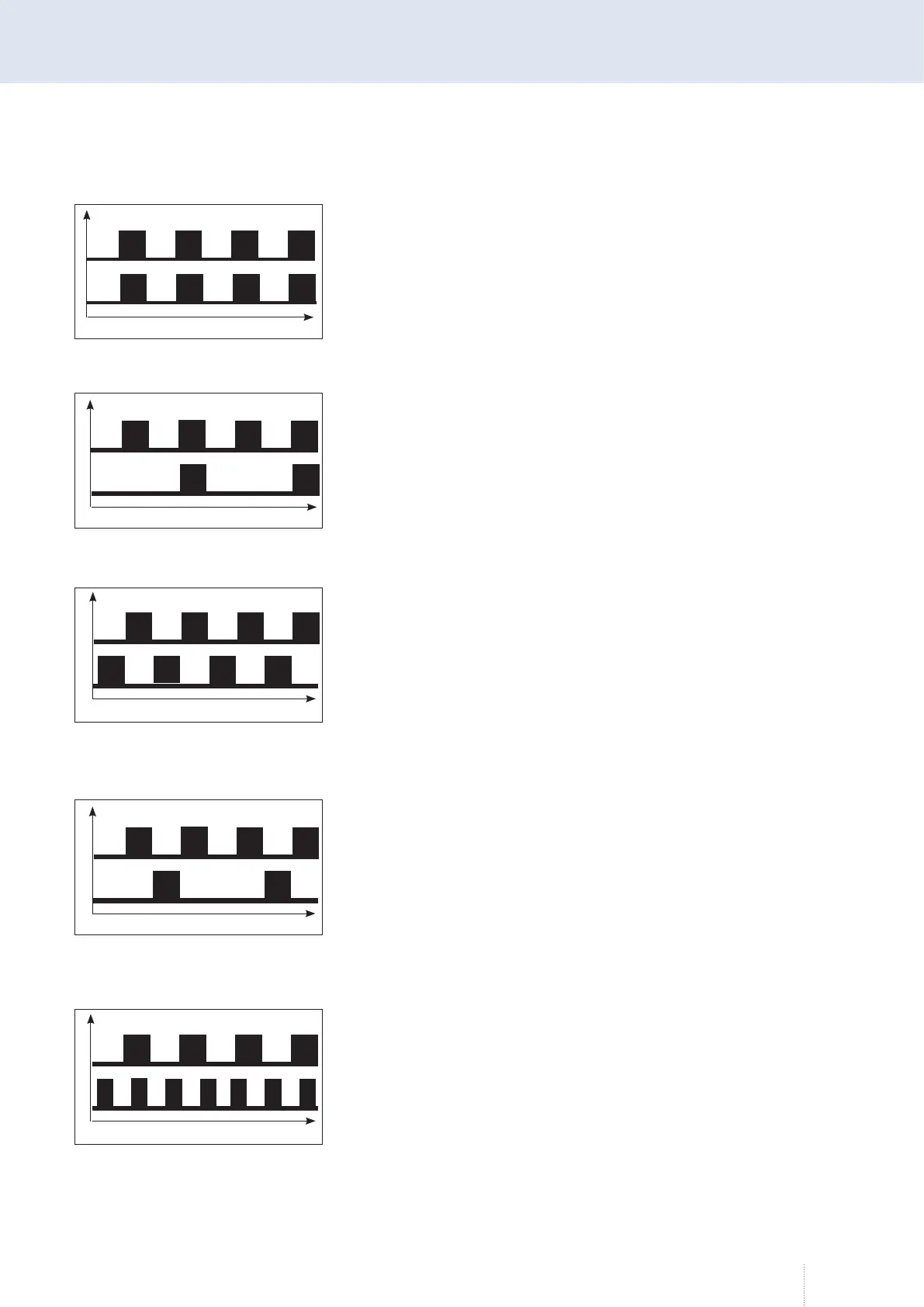
a1) Synchronous [ f
1
= f
2
]
With this adjustment all pulse phases [f
1
, f
2
… f
n
] of the welding power
sources involved are executed synchronously.
"Pulse generator (f
1
)" - "Pulse receiver (f
2
)" synchronous.
a2) Synchronous 1/2 [ ½ f
1
= f
2
]
With this adjustment the pulse phase [f
2
… f
n
] of the welding power
sources is synchronised with half of the pulse phase frequency of
the welding power source (f
1
). The pulse phases are synchronously
executed.
"Pulse generator (f
1
)" - "Pulse receiver (f
2
)" synchronous 1/2.
b1) Alternating [f
1
= f
2
]
The pulse phases [f
2
… f
n
] of the welding power sources involved alter-
nate with the pulse generator. The phase shift is adjusted at the pulse
generator between 10 % and 90 %. The picture shows a phase shift of
50 %.
Alternately synchronised pulse mode has a mostly positive influence
on the process stability.
"Pulse generator (f
1
)" - "Pulse receiver (f
2
)" alternating.
b2) Alternating 1/2 [ ½ f
1
= f
2
]
With this adjustment the pulse phases [f
2
… f
n
] of the welding power
sources are synchronised with half of the frequency of the welding
power source (f
1
). The phase shift is adjusted at the pulse generator
between 10 % and 90 %. The picture shows a phase shift of 50 %.
The pulse phases are alternately synchronous.
"Pulse generator (f
1
)" - "Pulse receiver (f
2
)" alternating 1/2.
c) Asynchronous [f
1
≠ f
2
]
With this adjustment all pulse phases [f
1
, f
2
… f
n
] of the welding power
sources involved are executed asynchronously.
Use this adjustment when a synchronisation, also alternating, is not
imperative during welding.
"Pulse generator (f
1
)" - "Pulse receiver (f
2
)" asynchronous
f
1
f
2
a1) t
I
a2) t
f
1
f
2
I
b1) t
f
1
f
2
I
b2) t
f
1
f
2
I
c) t
f
1
f
2


 To Next Page