Manuale operativo
CHORUS
16 Rev. 0 del 06/2012
2.1.4 M
OVEMENT OF THE SAMPLE TRAY
The only part of the moving instrument which might come in contact with the operator is the strip tray
(carousel), which partially extends outside the front opening.
To reduce this risk the instrument is fitted with a frontal lid that has to be kept closed during the tray
movement. To ensure this the system requires closing the lid before every tray movement.
For further protection, a control device for the tray rotation is included, the device automatically blocks
the tray, within a fraction of a second, whenever it detects an obstacle to rotation.
Given this additional security device closing the lid is optional, meaning that the tray can rotate even
when the protection lid is not closed.
It is still advised to close the lid every time the instrument is working, to avoid any casual blocks to the
tray during function.
A signal indicates that there is danger of an object hitting the instrument.
2.1.5 L
IDS AND
P
ROTECTIONS
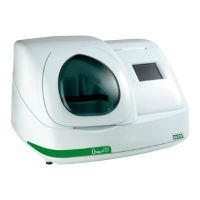
The instrument is fitted with two protection lids.
- One main lid, which prevents accidental interruption to the tray rotation during function which could
result in interruption of a cycle and lost tests.
This protection is also useful to prevent the operator’s fingers or hands from touching the moving tray,
and the protection reduces the already limited influence of external light on the optics of the instrument.
The use of a hydraulic piston helps to open the lid and keep it open. The lid will close only when the
operator pushes it.
Finally the closed lid prevents spats of serum from hitting bystanders during the execution of the cycle.
- A secondary lid which closes the compartment where the tanks are positioned. This lid is light and
does not create any dropping risk because it is permanently supported by its fixing screws.
2.2 ELECTRICAL RISKS
The instrument must be plugged in to the power supply using a regular, well-earthed plug in
accordance with regulations. The cable supplied by the manufacturer, which is in accordance with
regulations, must be used to connect to the mains.
There is no risk of electric shock for the operator because the instrument is adequately protected.
There is no possibility of causing an electric discharge and interrupting its function by touching the
instrument, because it is adequately protected.
The user must not operate if the cabinet has been removed.
It is advised not to use an extension to the connecting cable. If a cable extension is necessary, the
extension must conform to relative regulations, if it does not conform it may override all safety
precautions.
2.3 RISKS IN THE USE OF LIQUIDS
The instrument is not protected against liquid spills.
Local protections prevent damage in case of dripping, but large liquid spills can seriously damage the
instrument function, so:
- do not position containers on top of the instrument



 To Next Page