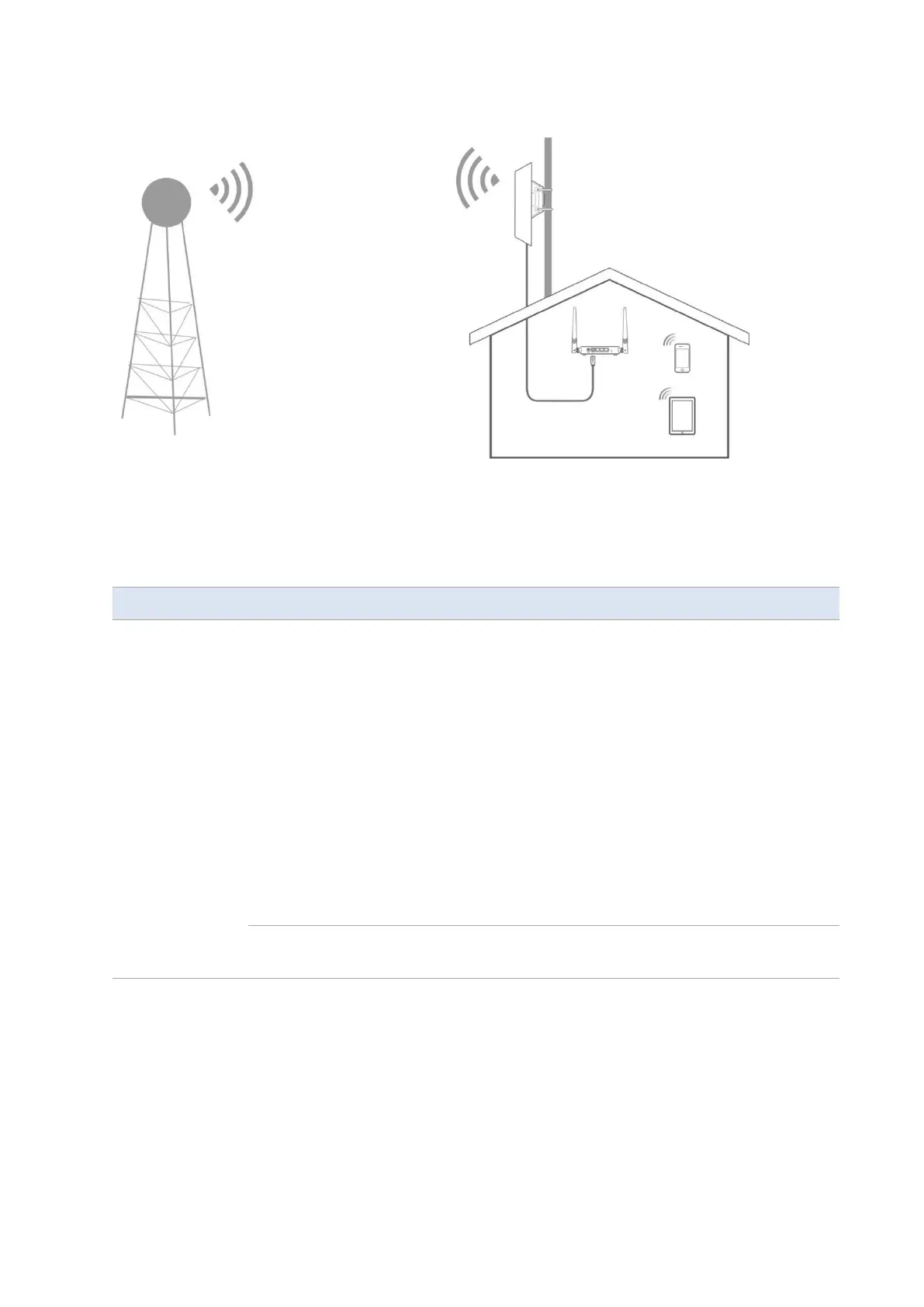
Chapter 1 Application scenario 5
4. Use the plastic straps to attach the CPE to the pole.
----End
Check the LED1, LED2 and LED3 indicators of the CPEs to confirm whether the positions are
proper. The more LED indicators light up, and the better the connection quality is. The LED
indicator descriptions of the CPEs below are for reference.
LED1, LED2, LED3
(Received signal
strength LED
indicators)
There is device connected to the CPE.
−
Solid on: The CPE may work in AP, Repeater, P2MP or
Router mode.
−
Blinking: The CPE may work in Client, Universal Repeater
or WISP mode.
Each LED indicator corresponds to a received signal strength
value. When the received signal strength of the CPE reaches the
RSSI threshold, the corresponding LED indicator lights up. You
can judge the connection quality based on the statuses of the
LED indicators.
By default, the minimum signal strength of LED1, LED2 and LED3
are -90 dBm, -80 dBm and -70 dBm. You can change them on the
Wireless > Advanced page of the web UI of the CPE.
No device is connected to the CPE, or the received signal
strength is less than the RSSI threshold (default: -90 dBm).


 To Next Page