Section 4: Theory of operation Model 2657A High Power System SourceMeter® Instrument Reference Manual
4-8 2657A-901-01 Rev. B/December 2012
Notice that as resistance decreases, the slope of the DUT load line increases. As resistance
approaches infinity (open output), the System SourceMeter instrument will source virtually 1000 V at
0 mA. Conversely, as resistance increases, the slope of the DUT load line decreases. At zero
resistance (shorted output), the System SourceMeter instrument will source virtually 0 V at 10 mA.
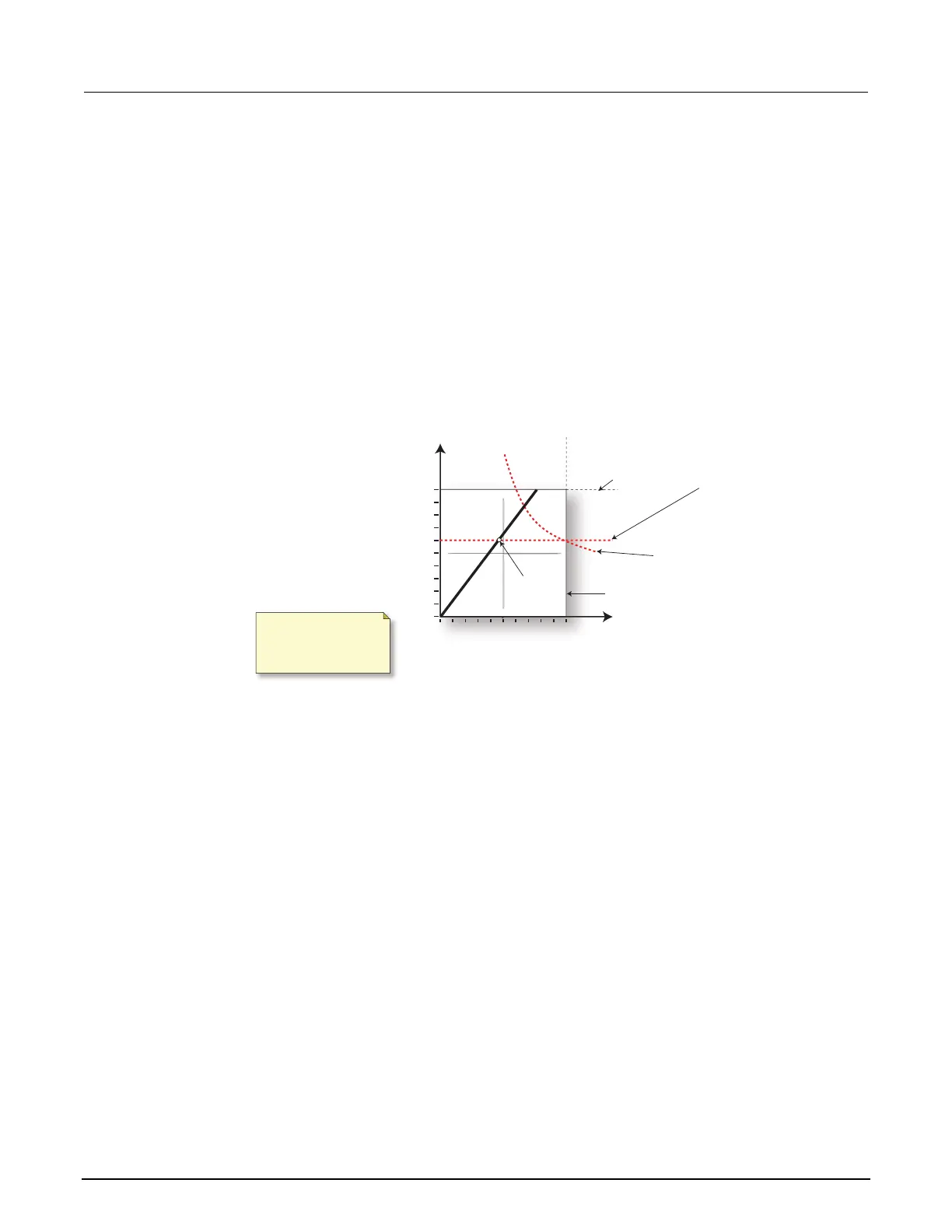
The next figure (labeled "V-source operation in power compliance"), shows what happens if a power
limit of 6 W and a current limit of 10 mA are applied. In V-source mode, power compliance
establishes a second current compliance limit, the value of which is determined by dividing the power
compliance limit value by the programmed voltage source value (for this example, 6 W / 1000 V = 6
mA). The instrument will enforce the lower of either the programmed current compliance limit or the
power-limited current compliance limit. In this example, the System SourceMeter instrument enforces
the power-limited current compliance limit of 6 mA and is not able to source its programmed voltage
(1000 V). For the 80 kΩ DUT, the System SourceMeter instrument will only output 480 V (at the 6 mA
limit).
Figure 73: V-source operation in power compliance
Current
compliance
limit line
Power
compliance
limit line
Programmed source value:
1000 V
Actual source value:
480 V
Programmed voltage
source value line
I-meter
(I
M
)
5 mA
10 mA
1000 V
500 V
I-source
(I
S
)
Power-limited
current compliance
limit line
Operating
point
V
S
= I
M
• R
= (6 mA)(80 kΩ)
= 480 V
80
kΩ
DUT Load Line (R)
X



 To Next Page